
To start with … my apologies to everyone that left comments in the last week and heard no response. I got a new iPhone and couldn’t get my WordPress or JetPack apps to work. We also left for Florida and I didn’t have my laptop or iPad to access the site. Sorry!
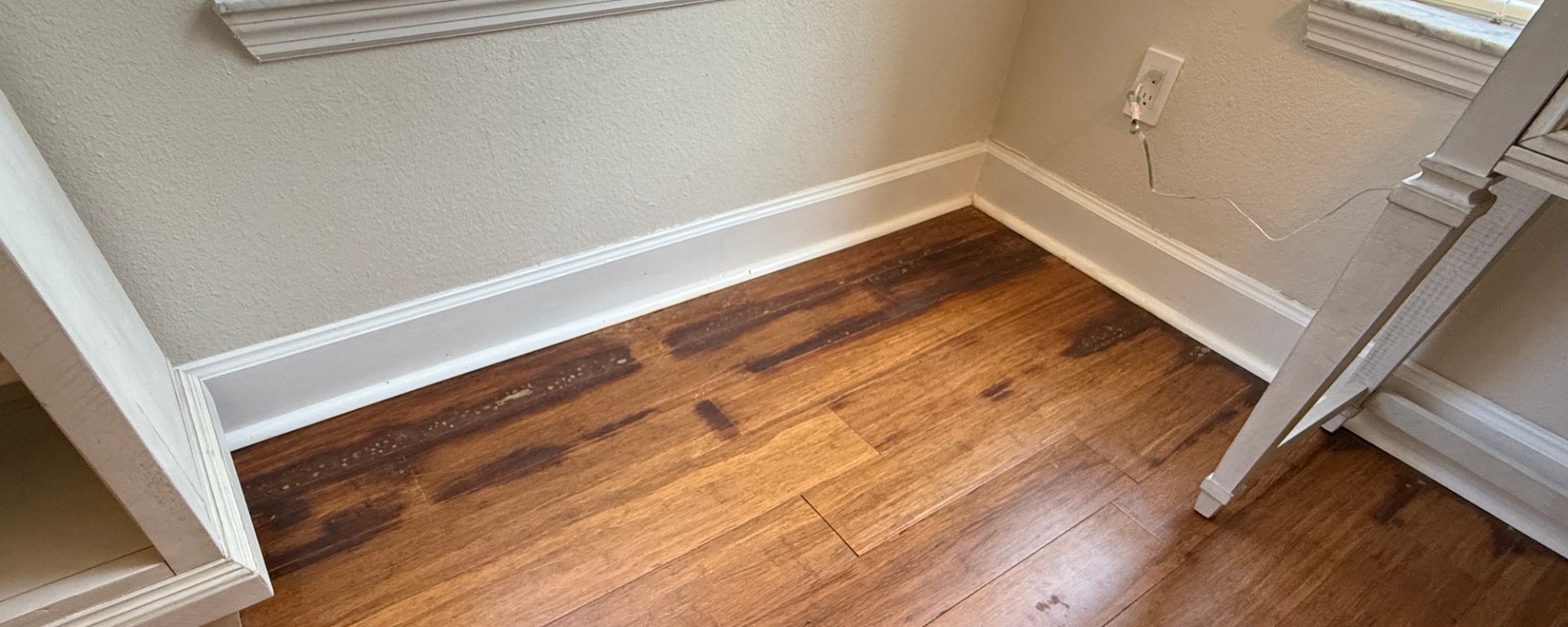
Speaking of Florida, it turns out we didn’t escape Hurricane Milton unscathed. When we got to our vacation condo last week Friday, we found water damage along two of the outside walls. The water probably extends about 16-18 linear feet.
I’m not sure how the water got in. Was it through the single-lane windows (which were closed & locked tight), through the exterior wall (stucco condo building), or up through the floor? Our genius handyman, Carlos, is coming on Tuesday morning and will be able to diagnose it for us.
We’re thinking our spiffy bamboo floors are going to need to be fixed. I’m not sure if they can slide in some new pieces, or if the whole thing has to come out. The room is large – about 350 square feet – so it won’t be cheap if it all has to be replaced. we already have calls into the Condo Association and our H06 Insurance Company.
Of course it’s critical we understand exactly how the water got in before we do anything. It’s not the last hurricane that is likely to fly over Florida. Still, I’m afraid this is going to be an ugly lesson in Florida personal finance & insurance. One of the reasons I was leary to add a vacation place to our early retirement lifestyle.
Image: My Living Room Floor!
 MrFireStation
I’m sorry to hear about the damage to your condo. Beware of the hidden damage under the exposed flooring. Do I assume correctly that this is a bamboo laminate floor with an underlayment cushion material? If so, how does that cushion material dry out? Do you have mold growth between the bamboo floor and concrete slab?
LikeLiked by 1 person
Yes – it’s a bamboo laminate. I’ve had a fan on it for 3 days and the floor hasn’t dried out at all. Clearly, something keeping it wet from underneath. We have our handyman coming this morning. He’s going to need to pull up the tile and diagnose it for us.
LikeLike
sorry to hear you got hurricane damage. Hope it’s not a huge headache.
LikeLiked by 1 person
Fortunately, it is in the corner – behind a chair – so out of the way. We’re guessing that the whole room will have to be torn up to replace it though. That will be a mess for a day or two – with lots of heavy furniture to move.
LikeLike
Sorry for your damage.
LikeLiked by 1 person
I live in the mountains overlooking the coast and have had to deal with 60 MPH+ wind driven rain over the past 35 years and have been forced to learn to identify sources of water infiltration and remediate them.
From your photo, it doesn’t look like the water came through the window, because I don’t see any streaks of water running over the sill or drywall. It also looks like your are not getting water seeping through gaps in the building paper underneath your stucco or flashing around the windows, because the photo doesn’t show any bubbling paint. Check around the parameter outside your unit for an insufficient gap between the soil and/or hardscaping and the bottom of your stucco. Also check that the ground slopes away from the unit. The current standard for fire safety and fire infiltration in LA is six inches from the bottom of the stucco metal flashing that allows water drainage. A common culprit is gardeners changing the drainage away from the unit or building up mulch over many years, which allows water to build up and seep between the interface between the top of the slab and bottom of the stucco.
Talk to your neighbors on the same side of the building who were present during the storm. Also get out your hose and blast any areas your theorize are the sources of leakage.
LikeLiked by 1 person
We think we had 75-86 mph winds and about 15” of rain. Agree with your assessment – we don’t think it came in the window, because we didn’t find any streaks – under this one or the other 4 in the room.
We’ve been looking at the landscape & taken a lot of pictures. There’s a big gutter that comes down in this corner of the building and we do see water spots on the stucco outside. I’m not sure if water got caught up next to the building or what?
LikeLiked by 1 person
High winds make the rain fall almost horizontal so it ends up places under the eaves. The 15 inches of rain also probably had a peak period where you received an inch or more over 15 minutes, which would have caused the gutters to overflow, with the wind then slamming the rain against the side of the building.
Are you able to see where the stucco ends and you have bare concrete for the slab? What is this measurement in inches? Or does has the landscaping mulch and soil hide this? If you cannot see where the stucco ends, dig down a little to see how far the landscaper has built up the soil and mulch. Also observe whether the soil slopes away from the building.
Here is a picture that shows what you are looking for with an explanation.
https://thestuccoguy.com/burying-stucco-weep-screed-with-concrete/
Resources like these help you get up to speed so that you are an informed consumer. Even when you or the condo association is hiring the work out, being informed helps. Also check if you condo association has an engineer on the board. One of my mechanical engineering buddies from my aerospace days became the engineer for his home owners association. He wanted keep active and liked working on problems like these.
LikeLike