

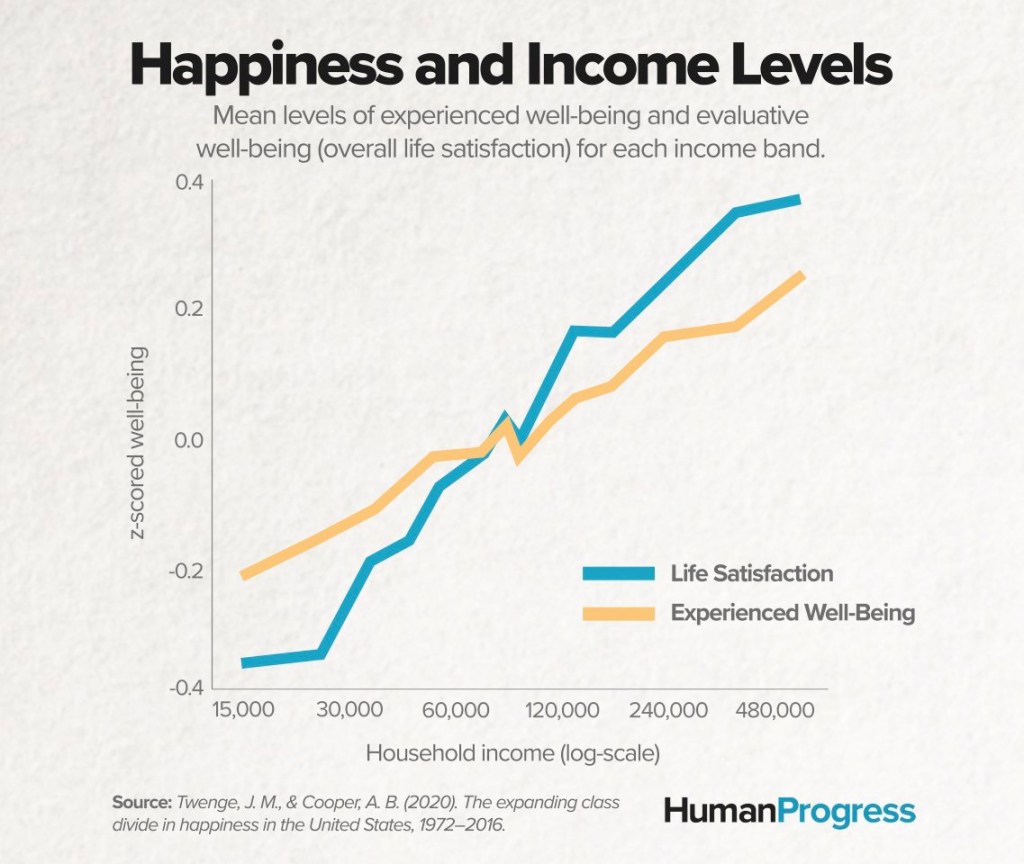
A friend who bought a new boat recently quipped, “if money doesn’t make you happy you aren’t spending it right.” Until recently, scientists debated that point, claiming that happiness topped out at about $75K/year in income.
That’s now changing. New research suggests that more money makes you more happy up to well over $500K/year. That’s a big difference and seems to make a lot more sense. The new study, which included input from the earlier one’s authors, surveyed over 33K people. Here’s the data …
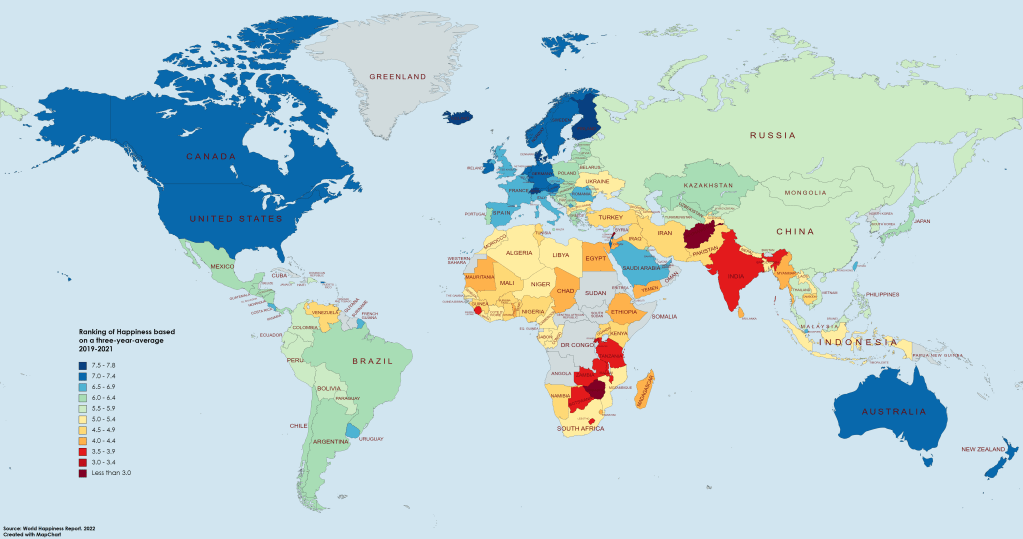
The strong connection between income & happiness is also born out in this map of the happiest places in the world. No surprise, wealthier countries in West Europe and North America are the happiest. Well off Scandinavian countries are near the top, while poorer African & Asian countries lag …
A lot of folks in the FIRE movement have used the $75K ‘happiness cap’ as support for a frugal-living approach to FIRE (financial independence & retired early). I’ve always felt that the folks that stop working at 30 to live in a van and eat rice & beans are taking a pretty risky route to life.
It’s their call, of course, but I know I’m happy we worked until we did (49+ years old) and accumulated enough wealth to live a nice retirement with a comfortable house, wonderful trips, and entertainment. Let alone not having to worry about having money for healthcare risks and insurance.
Perhaps this new study will help people see that having more money gives you more options in life. Not that you want to make life into a single-minded quest for wealth, but to be thoughtful about the amount of money you’ll need to make the most of the time you have to spend in retirement.
At what point of income do you think happiness starts top out?
Image: Pixabay
 MrFireStation
My response is having adequate finances to never work another day as long as you live while living well and without out living your money.
LikeLiked by 1 person
I guess the challenge there is how do you define “living well” for yourself. It depends on who you are and what your situation is relative to your past and the people you value in your life.
LikeLiked by 1 person
I went into retirement thinking I would have the same cash flow as I did when I was working and that was my prompt to retire. Why work if there is no financial benefit?
My preretirement projections were too conservative, so I ended up being much better off. My driving expense dropped, next month my health insurance will drop dramatically, and the biggest reduction was Social Security Taxes which are taxed a second time by Federal Income Taxes, a third time by State Income Taxes and then you go out and buy something with what is leftover and pay Sales Tax.
LikeLiked by 1 person
Yeah – I planned too conservatively, too. A bit on purpose, but also a bit more than expected. That’s a nice place to be.
The double & triple taxing of the same money has got to be the biggest scam ever. Now they want to tax ‘wealth’ after already taxing it as income?!
LikeLike
Donovan once sang: “Happiness runs in a circular motion
Thought is like a little boat upon the sea
Everybody is a part of everything anyway
You can have everything if you let yourself be“
In my long life experience the correlation between money and happiness is tenuous. It is highly individual. It is subject to change. Happiness is ephemeral, circumstantial, and poorly understood. Happiness is often realized in pursuits, not possessions.
LikeLiked by 1 person
I agree that happiness is in pursuits, not possessions. People live to pursue goals and achieve them. That said, money often allows you to pursue the more sophisticated goals.
LikeLike
I know that in 1985 at age 22 I thought that I was styling on $17,500 plus a company car!
All kidding aside, as long as my income exceeded my expenses I was happy. Having said that, there are a lot of highly compensated unhappy people.
I say that as I sit in a courtroom waiting for jury selection for a trial I am monitoring this week. I don’t need the income but it is fun and the income will accelerate the fully funding of grandchildren 529 plans
LikeLiked by 1 person
Yes, there are a lot of highly compensated unhappy people, but do you think it’s more than the % of unhappy poor people?
My first salary out of college was $20,160 (in 1989). I couldn’t believe I had a salary “in the 20s”. I thought that was really cool, even if I was underemployed.
LikeLike
No, many more unhappy poor people. Sit through jury selection in court and you quickly understand how missing a few days of uncompensated work impacts people, not to mention the health issues and parental and childcare issues persist in society. Far too many people allowing life to happen to them. Big problems in society with people wanting a higher lifestyle than they can afford. Vacation, sports events, concerts and fancy sneakers yet they can’t afford dental care or jury duty.
LikeLiked by 1 person
Agree – if you’ve ever seen that book (or show) called ‘Affluenza’, you appreciate how out of control people are in putting a “higher lifestyle” on their credit cards. It’s a disease, of sorts, that infects people deeply.
LikeLike
I think happiness tops out when you stop thinking about money day to day. How you save it, how you spend it. It’s just there. In the background
That is when I know to retire. When I can stop thinking about both sides of the ledger. Many post FI bloggers seem to obsess about the money until they make the leap to retire.
Once they are off life seems to take over and it drops into the background. Can’t wait for that to happen.
LikeLiked by 1 person
Agree – I know I think a LOT less about money now that we’re retired. I think money is always front and center when you are working, because that’s mainly why you are there. Once you leave, you have what you have and little opportunity to change it. You become content with what you have.
LikeLike