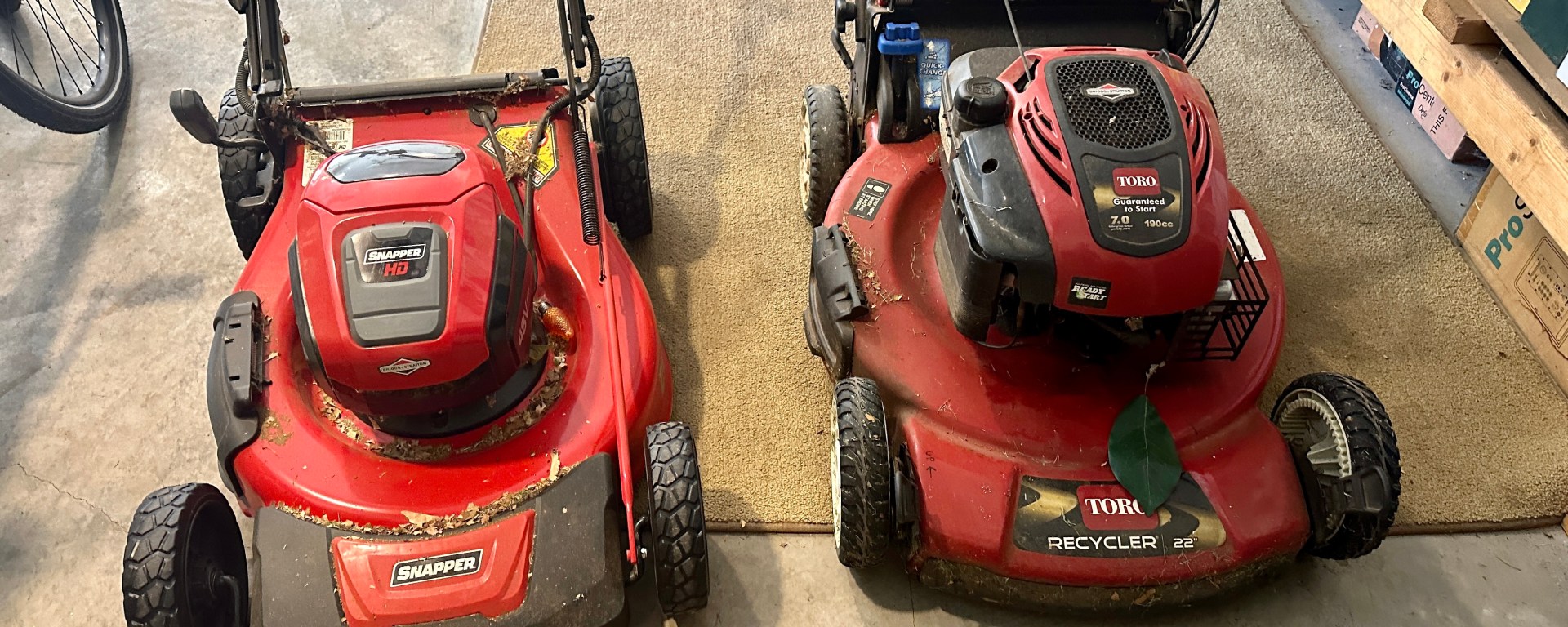

With the start of June, we’ve arrived into Glorious Summer in Minnesota- and peak lawn mowing season. At the FIRE Station, we’ve also made the full jump to an electric lawn mower.
When my folks moved to a senior apartment a few years ago, I bought my Dad’s Snapper Electric Mower. I used it now and then, but mostly relied on my trusty, gas-powered Toro.
Tired of having two mowers in my garage, I switched to the e-Snapper this spring and gave away the Toro. Now that we are about 6 mows into the summer, I have to say that it is really working well.
I hope that I’m saving in weekly energy costs, but the biggest benefit is that it is so quiet. There is a huge difference in how loud gas-powered lawn mowers are and this one. When people walk by when I’m e-mowing, they always comment on that. (Especially compared with the sound of the commercial mowers)
‘Quieter’ might seem like a small benefit, but a neighborhood full of electric mowers would be a LOT more relaxing. My son and I always joke how uncanny it is that every time we sit down on our screened porch to chat or read, someone fires up their noisy lawn equipment.
First world, suburban problems, I know!
Have you made the lawn equipment jump to electric?
(I should also note that the all-electric, Tesla Model Y, just became the best-selling vehicle in the world recently. Amazing how far EVs have come to even outsell the Toyota Corolla & Ford F150 truck)
HAVE A GREAT WEEKEND !
 MrFireStation
I live in a condo, so, no mowers for me. However, our landscaping company has definitely NOT made the switch and they rev up all kinds of gas-powered equipment for HOURS at a time!
Obviously, they have an uncanny knack for showing up any time I sit down to read or watch tv, make a phone call, take a nap….
As you said, first world problem. At least I don’t have to do yard work in our hot, humid summer weather.
LikeLiked by 1 person
Yes – The commercial mowers & string trimmers are the absolute loudest. In our neighborhood, about half the homeowners “hire it out”.
LikeLike
I keep a couple acres clear of brush for fire safety. With all the rain we had in California over the spring, I just mowed annual rye grass that was at least four feet tall. I just upgraded my mower to the Toro Commercial line, and wow, I really feel like a fool for not getting this grade of equipment sooner. Newer commercial gasoline powered mowers are fighting back on noise abatement. I wear my cell phone when mowing to listen to music. I received a call from a consulting customer and we were able to have a conversation, while I continued mowing. I was able to mow an approximate one acre field on one tank of gas.
I don’t think electrics could keep up with my property’s demands. My neighbors’ landscapers tell me they have dabbled with electrics, such as chainsaws. At first, their squirrels (the guys who climb trees) thought the electric chainsaws were great because they did have to pull a rope to start them. They soon fell back out of love with them after having to climb up and down the tree ten times to change batteries. For commercial crews supporting a full eight hour workday of mowing and blowing would mean carrying a lot of expensive batteries around and having to change them frequently as they lose their charge capacity.
An electric works in your case because you are only mowing your lawn and are not contending with brush. Another positive for your use case is that ethanol blended gasoline is horrible on small engine carburetors. I actually have a fuel shutoff on my mower and run my carburetor out of fuel at the end of the day. For my really small 2 stroke engines, I pay more for ethanol free fuel.
I don’t want a math, science and manual labor challenged attorney (civil serpent) who is totally devoid of knowledge in this area deciding what equipment I am going to use. Last week during your Homeowners Insurance post, State Farm’s refusal to provide fire insurance on new properties in the People’s Republic of California made its way into the conversation. Of course the press release went on with blah, blah, global warming. My wife and I are avid outdoors people who live in a rural area and our observation is the fire problems the state has had are caused by bad forest management that has been under the control of math and science challenged lawyers who populate the civil serpent class for half a century.
LikeLiked by 1 person
The property insurance crisis in California also involves land use planning and building code issues. Development has been allowed in areas with a history of wildfires. There has not been a corresponding requirement for fireproof construction and suppression systems including indoor and outdoor sprinkler systems. There are properties near Klaus that survived fires which burned around the properties due to proper protection. Yes, this is expensive to do but necessary to build in certain fire prone areas.
Allstate and State Farm stopped writing new business in all areas of the state, not just fire prone. This is not that different than insurers fleeing Florida due to the windstorm hazard. Unless an insurer can earn a profit, they will pull out.
I agree that forest management issues exacerbated the situation in the Sierra and Northern California, but the Napa, Ventura, Santa Barbara, Los Angeles, and San Diego area fires typically don’t involve forests.
LikeLiked by 2 people
I live in the middle of the Santa Monica Mountains National Park area. Yes, we don’t have giant trees except for the six Coastal Redwoods growing on my property. What the park does have is lots of chaparral AKA brush and it really burns. The LA basin was known for being smoke filled when only the Chumash Indians were living here, because the hill sides often caught on fire. Thinking we don’t have wildfires is a real knee slapper.
There is a much bigger story here about fire management. Back in 1989, when I built my house, State Farm sent an underwriter out to my property and he stuck a couple sticks on my property and told me, “If you cut your brush back to here by this time next week, then I will approve you to be insured by State Farm Insurance.” Guess what I did. I cut the brush back to the sticks and I got my State Farm Insurance. I have been cutting the brush back to where he put those sticks ever since. The underwriter’s sticks very closely correlate with the Fire Department’s recommendations for brush clearance.
Now let’s skip ahead to 1994. The Los Angeles area is shedding aerospace and defense jobs and six properties that adjoin my were lost to foreclosure due to people losing either their job or their customer base. One of the first things to go for people who lost their jobs when they were cutting financial corners to stay afloat was firing their gardener. This year also brought what was the fire that came the closest ever to my house. Still today I can see scorched Manzanita stumps that were burned by the fire. There were several houses that burned in my neighborhood. Ironically, none of them were insured by State Farm and were insured by the state government agency of last resort “The California FAIR Plan”. Making it through this made me a true believer when it comes to cutting my brush.
Let’s now move the timeline ahead to 2000+. The California Costal Commission has really cranked up their requirements to build in a Coastal Area. One of the most egregious requirements is limiting the chaparral clearance (chaparral is a libtard’s name for brush) to 10,000 square feet for a multiple acre property. Now imagine building a 5,000 square foot house, driveway and pool on that property. There is not much room left for brush clearance. It gets even crazier. The California Coastal Commission then requires the owners to add a deed restriction that absolves the CCC of all responsibility in the event their house burns down despite the CCC limiting the home owner’s ability to clear their chaparral AKA brush per the Fire Department’s and Insurance Underwriter’s Standards.
You can do all that you want in terms of building code enhancements, but if you have Sumac growing close to your house, it will burn. I have a neighbor who built his house out of fire safe brick. He had some Miami Vice style glass block windows in the walls and his Miami Vice walls actually melted from the Sumac.
This is a manageable situation, but you need to get the dumb ass eco terrorists who want us all to live in tenement buildings to stop calling the shots. Reasonable brush clearance with reasonable building code enhancements will keep you safe from wildfires. Insurance companies need to get their underwriters off their asses in office buildings half way across the country and back into field. The underwriter who stuck the sticks in the ground did a much better job than the fool who told me take down my ivy from an office in Dallas. Oh, in case you are wondering, I have never had a claim ever!
LikeLiked by 1 person
(Sorry for the late response – I was traveling).
Wow – Allstate pulled out of California too? That’s another big insurer. I suppose it will soon be like flood areas where the government will become the sole insurer.
LikeLiked by 1 person
(Sorry for the late response – I was traveling).
You’re right – commercial equipment is much more than I need for my house. That’s amazingly to hear that they are working on controlling the noise, though. The commercial guys in my neighborhood clearly haven’t gotten the message.
I have a buddy who’s son lives in California and works for the Forest Service. He confirmed that most of the wildfire issues there are poor forest management because the green lawyers are controlling the management as much as anything.
LikeLiked by 1 person
Your friend’s US Forest son probably wants to take a balanced approach. Yes, you can still have lumber cutting that is not clearing cut old growth. and improve the health of the forest at the same time. Due to corporate tree farming, the US has more land mass covered with forest than before the Europeans came here. There are also more deer,
Many, if not all of the environmentalist groups have been taken over by Marxists. The author David Horowitz, who grew up in a Communist household before becoming a leading Conservative voice said this. “The environmental movement is a watermelon. It is green on the outside and red on the inside.”
LikeLike