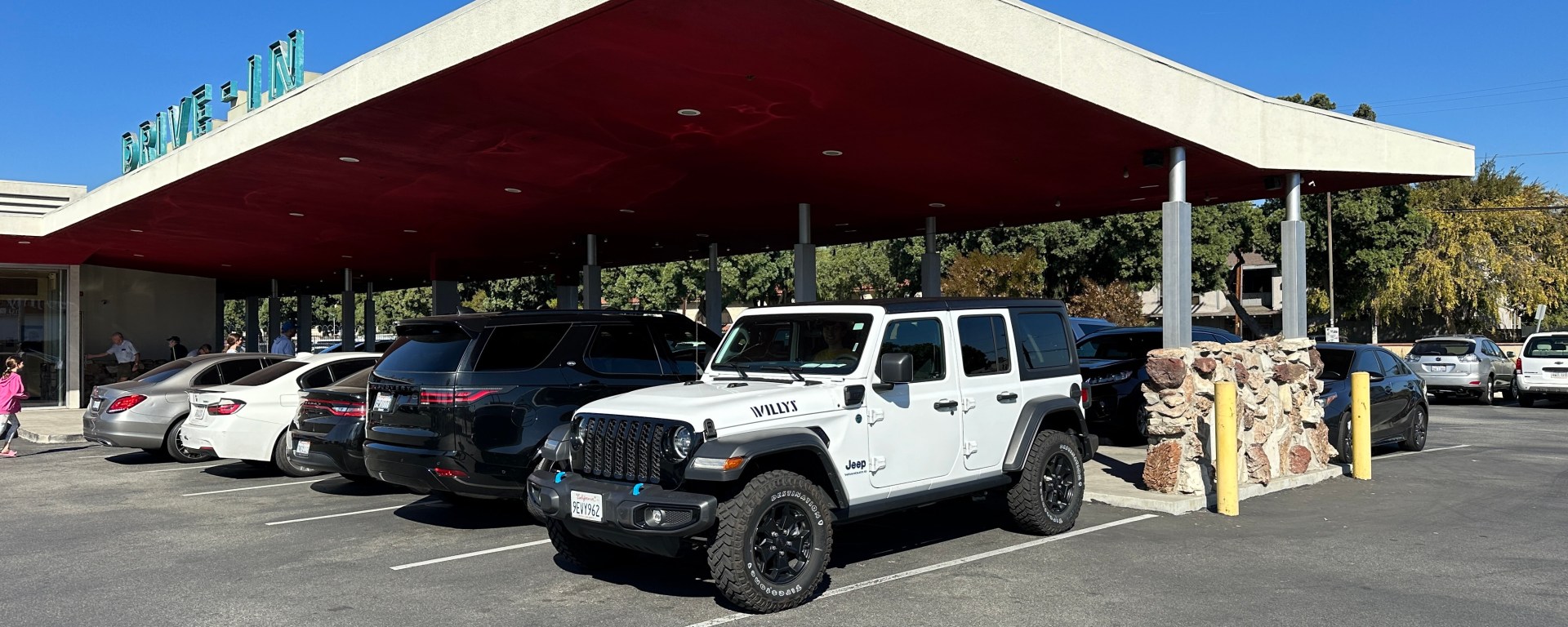
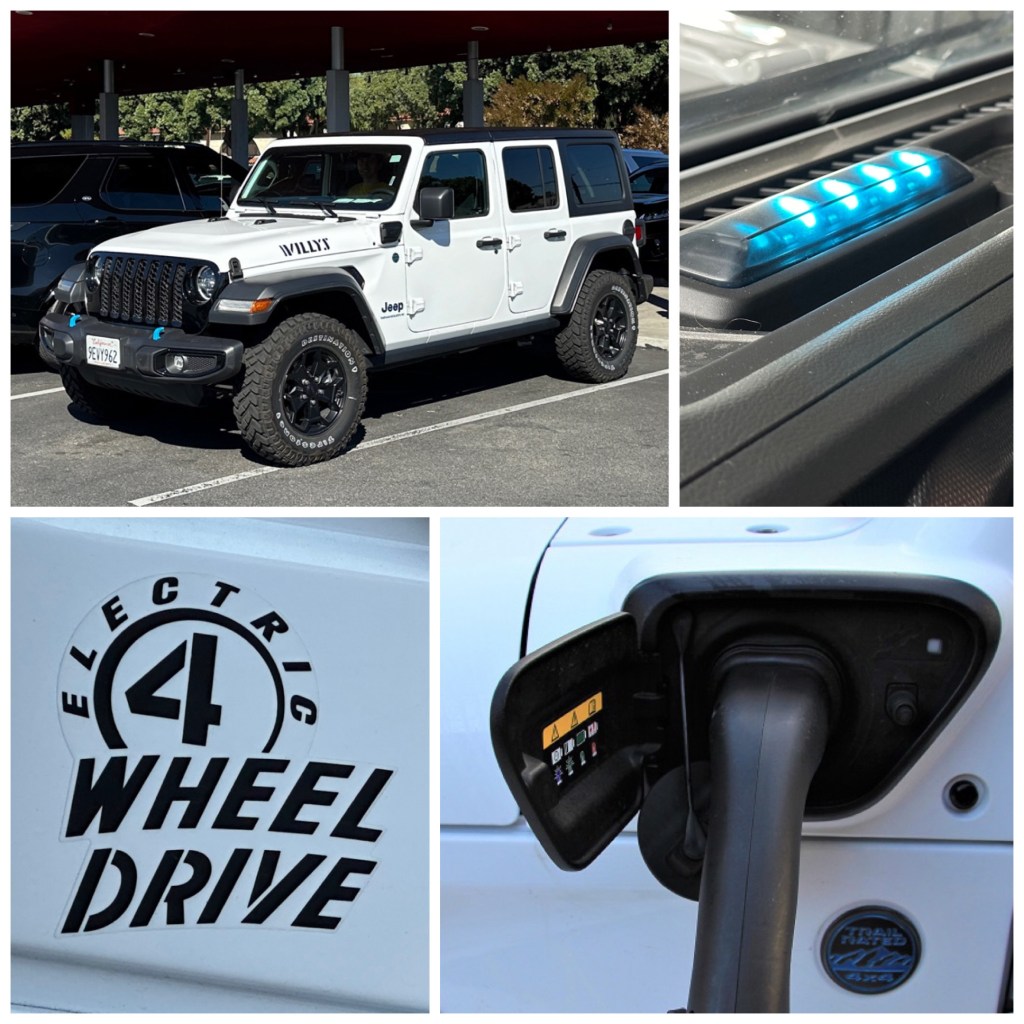
I had my first experience living with an electric vehicle last week when my son and I were in Los Angeles to fly on the Goodyear Blimp. It was a Jeep Wrangler 4Xe that we rented through Avis for the same price as a regular rental car.
My friend Jeff has been ‘mentoring’ me through the dollars & sense of going electric, but it was nice to get some first hand experience. This Jeep is a battery hybrid, meaning it has a limited range EV battery (~25 miles) and then it switched over to a traditional gasoline engine.
I was able to experience the process of having a EV for a few days and learn a bit about driving & charging it up. Here are a few observations …
SEAMLESS TRANSITIONS – Switching back and forth from EV to ICE propulsion is really smooth. The vehicle is so seamless in switching back and forth, I found myself looking at the tachometer to figure out which mode I was in.
NO PERFORMANCE ADVANTAGE – I wondered if the Jeep was going to be quick off the line in EV mode – as many EVs are famous for – but it wasn’t any different than in gas mode. I’m guessing the manufacturers try to match the torque levels, regardless of which mode you are in. If anything, EV mode performance is worse because the regenerative braking makes de-acceleration awkward.
CHARGER HUNTING – Our hotel in Anaheim didn’t have a charger and we had to hunt a bit to find places to charge. It’s funny, because you see them everywhere when you don’t need one, but you have to search a bit when you do. I’m sure there are good apps for finding them. We just used Google Maps.
HOME BASE – The best place to charge is certainly at home. If you just plug it in when you pull into your garage, you don’t have to deal much with the charger hunting – and get the best price/Kwh. That said, I have an electric lawn mower at home and J constantly forget to put the battery in the charger.
PRICES VARY – We paid $0.31/Kwh to charge our Jeep in Los Angeles, near the Academy Award Museum. That worked out almost equal to what it costs to fuel the Jeep with gasoline for the same mileage range. My friend Jeff has shown me his charging history and he often pays just $0.10-$0.12/Kwh, depending where you charge.. That’s a huge difference. Can you imagine if some gas stations charged $3.50/gallon and others charged over $10?
UPFRONT COST – Bought off the lot, a new Jeep EV Hybrid carries a $5K premium. There isn’t any subsidy / tax credit for them*, so you have to cover the upcharge yourself. At $3.59/gallon, that $5K premium would buy over 1,400 gallons and propel my Jeep about 31K miles. And, I wouldn’t have to pay the money out up front.
When I worked at MegaCorp, I did a lot of work on new product innovation strategy. I did a lot of best practice sharing in the company and at conferences. One of my claims to fame is that my articulation of the price/value equation was picked up by a Harvard Business School professor. Thinking through that lens, I’d say EVs aren’t quite ready for prime time on a financial basis.
The benefits of a new technology need to be markedly better than the incumbent they hope to displace. It’s not enough to be just a little better – it should be 25-33% better than what people are using today. That margin ensures that consumers will deal with the hassle of understanding the new technology and adopting new behaviors the technology may require. Using the Hybrid EV technology requires some learning & inconveniences.
Since the EV Hybrids just aren’t there yet, I would surmise that full EVs are even farther away, given their even higher upfront premium and greater dependence on charging. Please give me your thoughts if you think it’s just better to go all-in on a full EV.
While I don’t think it makes sense yet, I do think the EV manufacturers will continue to improve their offerings and that the technology may be markedly better than gasoline powered vehicles in the next 3-5 years.
I passed on buying a Hybrid EV Jeep when I bought my new Rubicon recently, but maybe when it’s time to replace it in a few years, the technology will be there.
What first hand experiences have you had with EVs? Do you have a different insights on the dollars & sense of them?
* Under a certain income level, PHEVs do have a $3,750 government credit. Mr. Fire Station does not qualify, but you might. Here’s the info from Consumer Reports … LINK
Images: (c) MrFireStation.com
 MrFireStation
Hertz for its most recent quarter reported bad financial results that they attributed to EV’s. Their quarter guidance stated that the costs associated with EVs were high in the following areas; 1) cost to charge, 2) cost to repair, and 3) resale value AKA depreciation.
Your statement about the technology not being ready for prime time tells the tale. The current generation is expensive and a better class of EV (if it comes along) will depreciate the previous generation faster.
You drove the vehicle in perfect driving conditions for EV’s. Batteries do not hold a charge as well in really cold weather like you have in Minnesota. Adding insult to injury, you need to run your car heater during really cold weather which will be resistive heating, resulting in even faster battery drawdown. There are plenty of news stories in publications such as the Wall Street Journal about the degradation of miles between charges falling dramatically during cold weather and trips that should have taken a reasonable driving day, taking a couple days.
My favorite recent example was the US Energy Secretary, Jennifer Granholm’s attempt to showcase EV technology by driving from Charlotte, NC to Memphis, TN. It took her three days to drive 650 miles with an advance team driving internal combustion vehicles to reserve her a spot at charging stations. Her advance team got the police called on them for parking their IC vehicle at a charging station to ‘reserve’ it for her. This is what got her in the news.
Jennifer Granholm as Energy Secretary explains a lot about the failing energy policy in the US. She is the first person in her family to go to college and graduated from Harvard with a Law Degree. Most lawyers with the exception of patent attorneys are not good at math and sciences. She even invested in an electric bus company that despite favorable government backing recently went bankrupt. The bus company is the Biden Administration’s Solyndra. The position of Energy Secretary needs to be held by someone with a strong engineering or physics background who has the capacity to understand what they are making decisions about.
LikeLiked by 1 person
I have a friend who works at Hertz and he said the charging has been quite an issue. The Avid hybrid Jeep we rented had 0% charge when we picked it up. I thought it funny that they don’t plug them in for people – the way the gas tank is full at pick-up. They had about 15 Jeep 4Xe vehicles in their lot.
I agree with you on the government silliness when it comes to EVs. I was happy to hear that the hybrid EVs were not covered by subsidies. That said, right now they are a better choice than a full-time EV for anyone that has range anxiety.
LikeLiked by 1 person
The government silliness is best case stupidity and worse case corruption. I agree with you that hybrids have a reasonable return, while EV’s don’t. Where do the dumb politicians and those who vote for them think the electricity is going to come from? Unicorns flapping their wings in front of windmills?
LikeLiked by 1 person
I’m afraid that Unicorns are far from an endangered species in Washington DC.
LikeLiked by 1 person
You have got my attention. I agree, EVs except in specialized situations such as short delivery vehicles are not worth the extra $$$. I bought my Prius in April 2018 and have 42,000 miles on it with an average of 55mpg. I posit the opinion that hybrid is truly the way to go.
When I bought my Prius I was still working and a colleague bought a plug in and spent $6,000 more while receiving a $3,500 tax rebate/credit, but he did spend a bunch of money to install a charger in his house. His benefit was use of the HOV lane and he thinks savings on fuel by charging at home. At 55mpg I question his savings.
My son in law had a plug in Mustang that I drove from Colorado to Virginia in 2019. The tires were choppy likely due to uneven wear due to quick off the line starts. He could not do a roundtrip commute on a single charge in Virginia so he sold it and bought a Tesla. Back in Colorado three years later he bought a Tahoe for when it snows as the Tesla doesn’t do well at 7,500 feet in snow….at least the Tahoe is a hybrid.
Fedex has all electric trucks delivering packages in Pasadena and the drivers love them. Yes it makes sense for local delivery vehicles that are parked and charged overnight but the real savings is maintanance.
I still question young people with huge trucks or cars with large motors which they modify with a new exhaust which sounds like they need a new muffler……yes I am old. Stupid young people wasting money on vehicles they can’t afford…I am off topic
LikeLiked by 1 person
Agree – The switching costs of getting a PHEV or EV are significant. My understanding is that you can charge with a simple 110 outlet, but most upgrade to a 220 volt outlet.
None of my vehicles does better than 25 mpg, but there are a lot of good choices – Prius, Civic, Corolla, etc – that give you remarkable fuel efficiency without going EV.
LikeLike