

We’ve had a busy couple weeks here in MN, despite a run of bad weather. My summer schedule of yard work, biking, pickleball, tennis and waterfall hiking are already in full swing. I’m also a bit sore from too much doing!
My wife heard on the radio that most people stop working out at about age 49. We’re in our late 50s, so that statistic had us feeling proud what we did to earn of our muscle aches!
I went to Goggle Gemini and asked it to find a study & chart the data of how many people are “regularly working out by age group”. The CDC had data from 2020 …
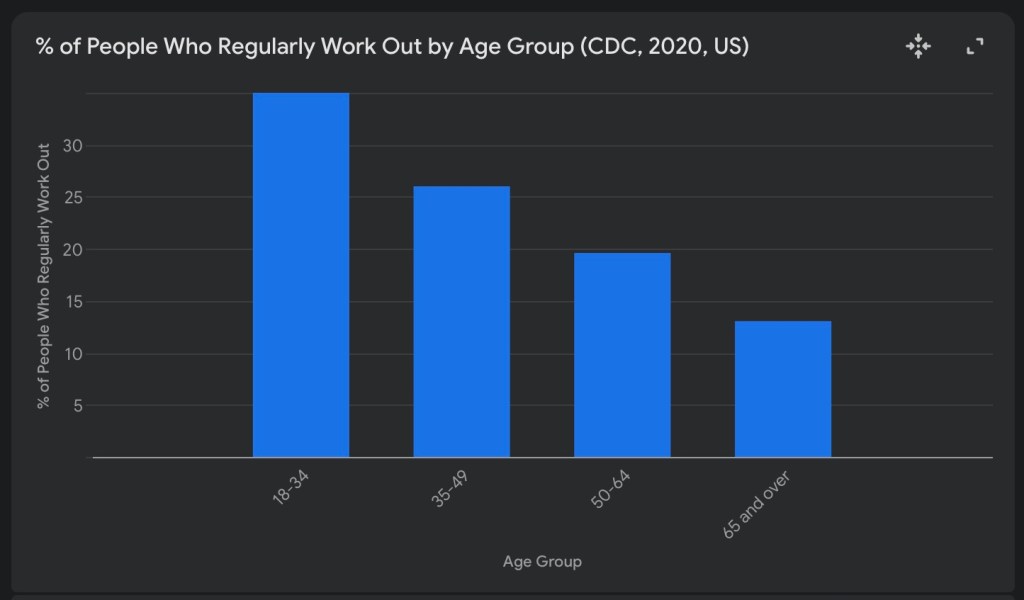
As you can see, it turns out that few people ever START working out regularly. Only 35% of young people are working out and it goes down from there. By our age group (50-64), the number is only 20%. That means 4-in-5 are pretty sedentary. I’m surprised it’s that low.
What regular fitness activities have you worked into your retirement?
Image: Google Gemini
 MrFireStation
The usual suspects for daily exercise….walking, biking, pickleball, and yard work.
That being said, we need to start incorporating more strength training into our routines. Muscle loss after 50 is a problem which can lead to more problems. The strength training does not have to be elaborate or expensive. It can be as simple as push-ups, pull-ups, stretch bands, and/or dumbbells. The key is to do it and mix up the exercises to work a variety of muscles.
I also try to work in HIIT workouts once/week. HIIT stands for High Intensity Interval Training. It sounds complex, but it is really just doing sprints either on a bike or running for a short time….and then a recovery period before doing another sprint. In my case, I do running sprints for about 20-30 seconds across the outfield of the ballpark in our local park. Then my recovery period is 1-2 minutes as I walk back across the outfield to my starting spot. I’ll do this 10-15 times and the grass tends to be more cushioning than running on trails. The benefit is getting the heart rate elevated in a very short time. I checked with my doctor about HIIT workouts, and he strongly encourages them and cleared me to do them based on my health status.
To ask a question back to the group, what devices do you use to help with health or exercise monitoring (heart rate monitor, watch, ring, etc.)?
LikeLiked by 2 people
Strength training & high intensity training are both probably missing from my activity. I was doing a weight circuit this winter in our clubhouse weight room, but haven’t continued it when we got home from snowbirding. My heart rate gets elevated in tennis & pickleball, but not like it would in running sprints.
I’m pretty integrated into the Apple ecosystem and use the Apple Watch, my iPhone (16 Pro), and AirPods. I don’t have any other hardware and only use the basic Apple apps.
LikeLiked by 1 person
Since retiring, physical activity went from being a high priority to a top priority. Here is my exercise regime.
During Covid-19, going to the gym became a real pain with the masks, hand sanitizers, outdoor workout area, and ironically because there wasn’t much people could do, my gym was packed. I bought my own Power Rack, Olympic weight set, Ex-Curl bar, dumbbell set, bench that I setup at the power rack, and a 20 inch step.
On Tuesdays and Saturdays, I do legs consisting of Dead Lifts, Squats, Calf Raises, Single leg split squats and either farmer’s walks and/or walking lunges holding a weight plate over my head.
On Thursdays and Sundays, I do bench press, next are supersets of standing curls, shoulder raises Front, Sides and Back, and laying rotator cuff extension. Finally, I finish up with supersets of pull ups and bent over rows.
My weight workouts take around 45 minutes because I don’t have to wait for any piece of equipment. I also don’t have to drive to the gym. The emphasis of my weight program is maintaining strength instead of building size. All of the exercises except bench press are done standing up, which works your core at the same time. I listen to music and read between sets.
Everyday, my personal trainer dogs take me for at least a 45 minute hike up and down the mountainside where I live. Whenever, I go shopping and park my car, I walk from store to store with multiple trips back to my van. This increases your daily step count a lot.
On weight days I also do stretching exercises to maintain and improve my range of motion. I particularly target my ankles, hips and shoulder/scapula. I use an interval timer on my cell phone with a minute per stretch. Range of motion is important for avoiding achy joints and injuries.
I live on a couple acres and maintain the property myself. Figure at a minimum three hours per week cutting brush and filling three roll-off carts. I also spend another hour and a half mowing, line trimming and blowing. Most gardeners are lean. This week I am doing more than normal, because I have field to mow in front of my house. I also have slope that has to be line trimmed. So for this week, I am putting in around an extra two hours per day to get my property ready for the annual fire inspection.
Shobod asked about activity tracking devices. I use Android and it has a built in activity tracker called Fit. It tracks daily steps and a value called Heart Points. The American Heart Association weekly Heart Points recommendation is 150, which equates to roughly 150 minutes per week of fast walking. My norm is around double the recommendation. I also weigh myself occasionally using a scale that calculates percent body fat, muscle mass and metabolic rate. These are much better metrics than BMI, which doesn’t account for whether your weight is fat or muscle.
Here are two mantras that are important to fitness. 1) Abs are made in the kitchen, not the gym. 2) If you make wise decisions in the supermarket, you only have to have will power once. If you buy a bunch of junk food, you have to have will power every time you walk by your kitchen.
LikeLiked by 1 person
No surprise to me that you are all over it, Klaus! You set a good example for all of us … cardio, strength, stretching. You should live to 1,000! 🙂
Heart Points sound like a version of the Aerobic Points System popularized by Dr Kenneth Cooper back in the 1970s. That’s the system that my cardio rehab work was based on. I wish the Apple ecosystem tied back to it. (I should look to see if there is another app available that utilizes that approach).
Cooper is still alive at 94!
LikeLiked by 1 person
The Heart Points system isn’t perfect. I noticed that it assigns less Heart Points when you are walking up a hill instead of down, and gives you even fewer when you pushing a lawn mower or wheelbarrow. It only seems to trigger off your walking speed. My breathing tells me different.
Would surprised that your Apple Physical Watch doesn’t support this value or equivalent. It should do a better job than my Android because Apple Watches track heart rate. Does it have an altimeter, so it is aware when you are walking up a hill?
In the case of Android, all I did is have to learn about the capability that was built in and make a link on my homepage to see it. These tools are best used to measure relative performance and as a source of motivation.
Here is a simple way to incorporate High Intensity Interval Training into your routine. In my case, pulling the three yard waste bins up the slope behind my house is HIIT. At the gym you can do supersets where instead of resting between sets you work another muscle group. Farmers walks where you simply hold heavy dumbbells and walk. If they have a sled push it. HIIT are basically butt kicker exercises where you have to stop between sets to recover. Only takes about 15 minutes and they spike your metabolism for 36 hours. You will feel a workout buzz afterwards.
Stretching only takes me about 20 minutes three to four times per week and is one of the most important elements. I linked a website that teaches you how to gauge which of your joints lack a full range of motion and teaches exercises that target them. We all have a lifetime accumulation of injuries. The ankles sprains we didn’t rehab during high school athletics, tight hips from sitting in chairs instead of squatting or sitting cross legged like primitive cultures, and the shoulder injuries from throwing. This was my weakest area and if you work on it you will see rapid improvements in terms of increased mobility and less pain. This will help you avoid injury when doing activities such as pickleball.
https://www.setforset.com/blogs/news/test-your-mobility-now
My personal trainer dogs are telling me they want to add the title Cardio Rehab Specialists to their CVs.
LikeLiked by 1 person
My dog isn’t big enough to be a Cardio, rehab specialist. His title would be “post workout massage therapy trainer”.
The Apple Watch works on what they call fitness rings. You get three rings each day… 600 cal burn, 30 minutes of exercise above a certain heart rate, and 12 times standing. I’m sure there is a science behind it, but it’s hard to know exactly how it is calculating what a calculates. Like you said, there are certain activities that seem about suspect.
As I get older, I find that stretching is the most critical. Most of my injuries have come because I wasn’t properly stretched out. At the same time, it seems that once you lose a certain bit of flexibility, it is very hard to get it back.
LikeLiked by 1 person
150 heart points equates to roughly 30 minutes per day walking at a fast pace five days per walk, so three rings per day sounds like you are covered.
If I could go back in time, I would have started stretching in my teens at the same time I started weight training. I watched a five morning webinar by a sports doctor last week and he stated that Pro Football which is a brutal actually has more injuries from non-contact than contact.
Here is something to try. I found that doing many yoga poses caused me instant cramps and pain. I used to go to yoga classes with my wife and jokingly called it, “Oh F&*! its yoga.” Recently, I started using a dog leash to act as a sort of extension cord, so that I can do as much of a stretch as I am capable of doing without all the bad stuff. After holding tension for a while in a stretch you will feel your muscles give up fighting the stretch and will slowly allow you to go deeper into it.
LikeLiked by 1 person
I’ve never tried any yoga stuff. That would probably be a great idea.
LikeLiked by 1 person
Keep up the great work Klaus!
LikeLiked by 2 people
Thank you!
LikeLike
Yoga will help your Achilles. This type of training will target the area that is most men’s biggest weakness, range of motion and flexibility. I always thought yoga was wimpy and during my first class I had to leave for a few minutes because I felt like I was either going to puke or pass out.
That being said, learn to use a yoga strap or dog leash so that you can start out slowly and do as much of the stretch / pose that you can do without cramping or hurting too much. Being stoic and fighting through the pain will not increase your range of motion because your muscles are used to the injury and are trying to avoid movement. Using a strap to slowly work your way into a poise will allow you tire out your muscles so they give up the fight and allow you go deeper into a pose that you can get with your body fighting it.
You will definitely feel better after a couple weeks.
Here is a five day course I took a couple weeks ago that shows you how to assess your joint mobility to identify the problem areas. Day 1 – Feet and Ankles. Day 2 – Knees and Hips, Day 3 – Back, Day 4 -Shoulders. At the end you can buy a video or sign up for their coaching. I was able to add a couple exercises simply from watching and following the video exercises and didn’t need to buy anything. I liked the course because it allowed me to focus on target areas. A yoga class will be too general.
https://bodyfix.thefitnessdoctor.com/?ref=mtcxntgv
LikeLiked by 1 person
A yoga strap was one of the “tools” the orthopedic place gave me and had me work with. I still use it. I’ve been back to 100% fitness for 18 months now. Previous I njuries to my back, Achilles, and hamstring / quads have made me a very diligent stretcher!
LikeLiked by 1 person
Sounds like you had a great program that not only helped you recover, but after recovery avoid further injury.
LikeLiked by 1 person
Here is a story you will love about a dog who is a Squat Trainer.
https://www.theepochtimes.com/bright/video-man-brings-service-dog-with-him-to-gym-but-watch-what-happens-when-he-does-squats-5671127?src_src=Bright&src_cmp=bright-2025-06-06&est=m1JKtjiKamfVzoznClWtVQEf3hVaj8avTsT2HtiLVLtds%2B0m95sTMk9F512Pym7x2yQ%3D
My wife and I just started watching the series “Hudson and Rex” on UP Faith and Family that we subscribed to on Amazon Prime Video. Now you and your wife like animal movies. The pilot was weak but the series is pretty good.
LikeLike