“Grateful Americans will come to this shrine of quiet valor, this forge of our Republic’s iron core. Valley Forge symbolizes the spirit of sacrifice that made independence possible.”” President Ford, Independence Day 1976
Just one post this week as I am traveling around some patriotic stops on the East Coast. I often say that early retirement is like “kidadulthood”. That is, it gives you the opportunity to revisit things that you enjoyed as a kid with the time, smarts, and money of an adult.
The Bicentennial happened when I was 10 years old in 1976 and I was all in. Our small town in Michigan was decked out in red, white, and blue. My 4th grade teacher taught us about the American Revolution, we did Colonial crafts, made recipes, and saw the Bicentennial Wagon Train come through our County Fairgrounds.
I watched President Ford on TV that day saw him dedicate the new Valley Forge Historical National Park. He went from Washington DC to Valley Forge to Philadelphia to New York that day. I pulled up his Presidential itinerary for that day. He called it “the greatest Fourth of July any of us will ever see”.
It’s been fun this year for me to stop at almost all of those locations. In late, March, my wife and I went to Washington DC for the cherry blossom festival. On that trip, we spent a couple days in colonial, Williamsburg, Jamestown, and Yorktown. I started watching the Ken Burns PBS series about the American Revolution and reading more and more about it.
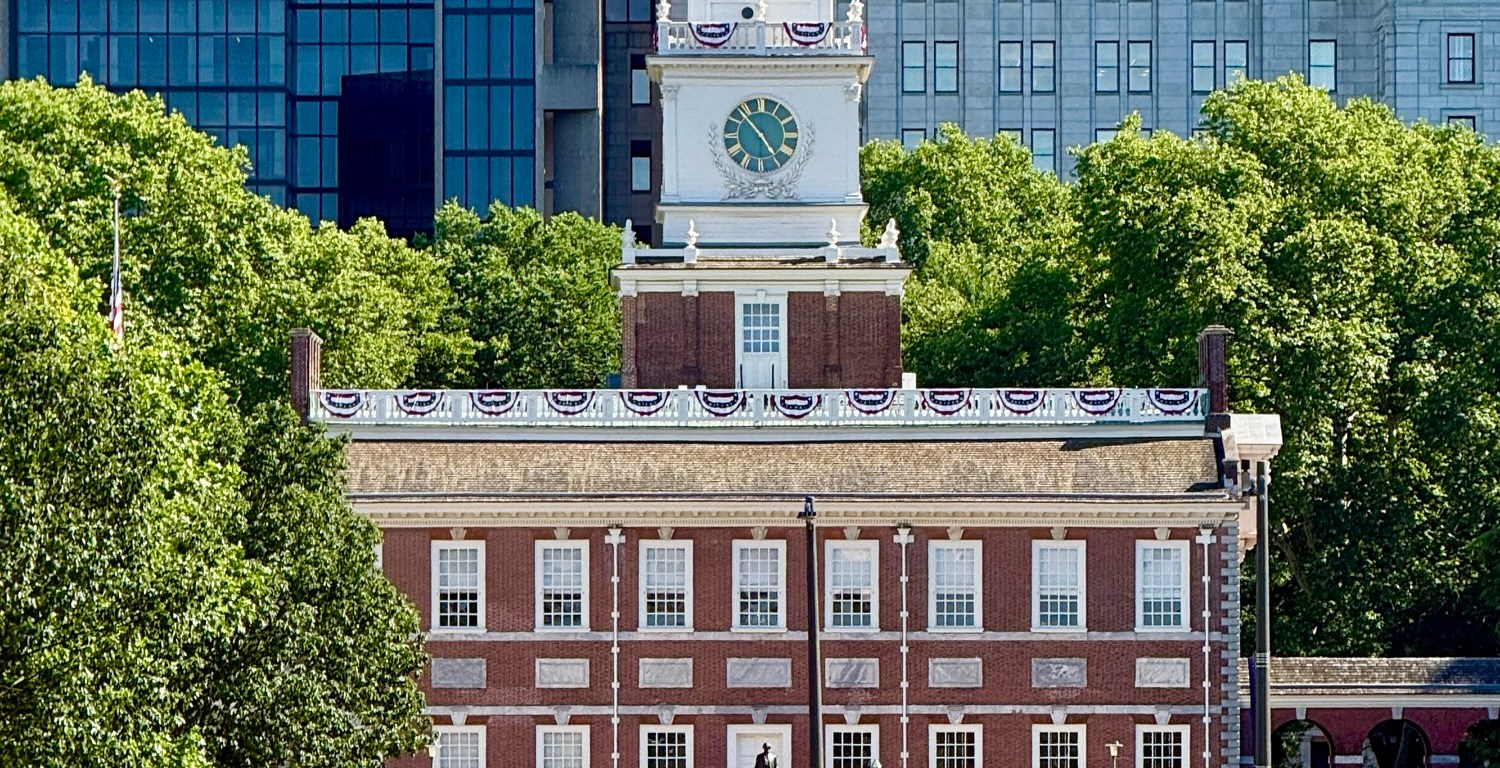
On this trip, I came to Philadelphia and spent three days in the Independence National Historic Park. I went to theatrical programs inside Independence Hall and Carpenters Hall, where they had actors portraying John Adams, Benjamin Franklin, Thomas Jefferson, and others, debating the complicated issues of independence, natural rights, slavery, and religion. I even got to raise the American flag at the Betsy Ross House on the morning of their Flag Day Festival!
I also took the Amtrak train up to New York City and walked through the historic downtown. Near Wall Street is where Washington set up headquarters in the city near Trinity Church, and where Alexander Hamilton is buried today. An old friend and I met up at the Fraunces Tavern – the oldest building in New York City – where Washington frequently and gave his famous farewell address.
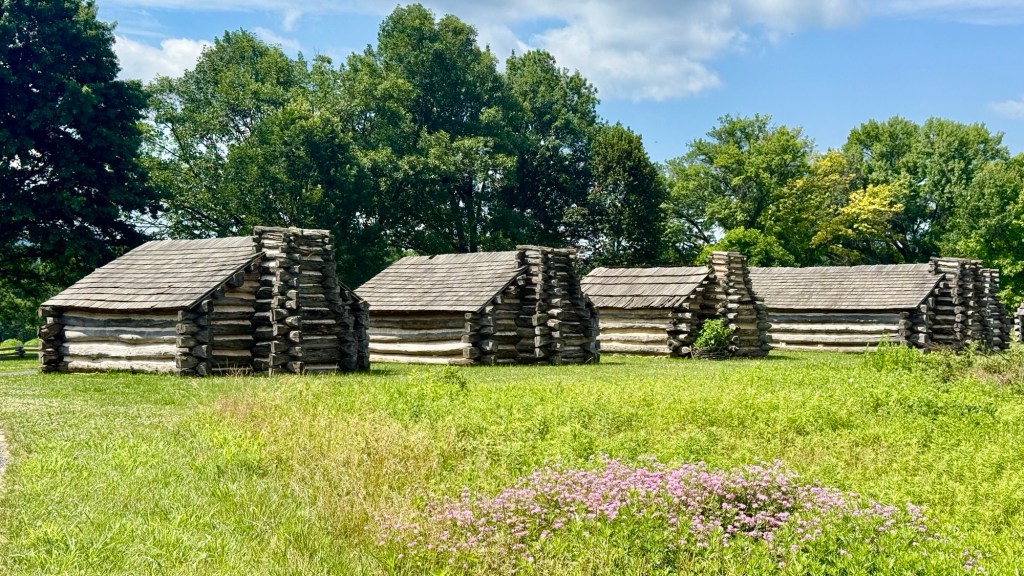
The weather for this trip has been absolutely perfect. This morning, I drove my Mustang convertible rental through the Valley Forge National Historic Park. What a great way to see the encampments, earthen forts, and monuments. Later, I’ll be heading to Washington’s Crossing PA, where the Continental Army crossed the Delaware on Christmas Night 1776.
Yesterday, I enjoyed a frosty beverage with a friend who lives near here and we talked about the history of this place. He put together a fascinating presentation on two of his ancestors that served in the Revolutionary War. They participated in/supported the 2nd Dragoons – the horseback light cavalry that served as Washington’s eye’s & ears – spying on the Redcoats.
In between my stops, I’ve also been studying part of my wife’s (and son’s) family history and her ancestors from the Valley Forge area that served in the war. Her 6th Great Grandfather and several of her 6G Uncles. Her 6GG enlisted as a private in the 5th Pennsylvania Regiment in February of 1777. One of her Patriot uncles is buried about 25 yards from Benjamin Franklin (and other “Signers” in Philadelphia.
They say that American history is uncool and overly politicized now, but I’ve really enjoyed these trips. The politics around America 250 were evident in 1976, after all (LINK). Like me, the people that I meet at these stops are interested and moved by what they are learning.
Any “patriotic plans” between now and Independence Day 250? How much do you recall about the 1976 Bicentennial?
Image: (c) MrFireStation; Valley Forge PA
 MrFireStation
I had just finished my Junior Year in high school in small town Wisconsin in 1976. As a country, everyone seemed to be on board with Bicentennial. I don’t see the national unity for the 250th.
LikeLike
Every other kid I knew in elementary school was pretty excited, but it was a very political time. Nixon had fired the Bicentennial Commissioners and appointed a bunch of partisans to the Board. They couldn’t get consensus on national events and the big East Coast cities were an absolute mess at the time – bankrupt, crime-ridden, and filthy. The original theme was going to be “Urban Renewal” – which quickly became a euphemism for knocking down history and replacing with low-income brutalism. Before 1976, the planning group was ultimately dissolved and they just opted to give the budget out as grants to local events. The Tall-Ships in NYC, Freedom Train, and “reverse” Pioneer Wagon Train were the events that got the most notice.
Here’s a great piece by Bill Maher on why we should all celebrate now … https://youtu.be/qVQJeHvI_AI?si=KLPr-v9m6cmdmpjW
LikeLiked by 1 person
I don’t remember any of these negatives from the Bicentennial. Thanks to Richard Nixon, I didn’t have to go to Vietnam. Thanks to Gerald Ford, I didn’t have to register for the draft.
LikeLiked by 1 person
The Vietnam war was a huge debacle. When I was in grad school, we read the Barbara Tuchman book “The March of Folly“. I believe it was a Pulitzer prize winner. It has a chapter on how bad the decision making was that advanced our involvement there – from JFK to Lyndon Johnson.
LikeLike
I remember standing in the damp cold, March evening at a railway siding in Portland Maine waiting to board the Freedom Train. This was a special rolling museum of US artifacts. If I recall correctly, we entered at the rear of the train and walked car by car through the “museum”. I wouldn’t be surprised if it was also a method to promote rail travel despite no passengers on the train.
I was 13 at the time and had visited Boston many times and NYC. This was one of those must-see events, that didn’t live up to the hype. Somewhat like looking at Plymouth Rock!
My wife and I had a similar experience at the British Museum 15 months ago. We spent some time in the Egyptian and Greek exhibits and realized that we had seen everything displayed before, but in their natural original location. Travel ruins such experiences, but I agree that such museums bring antiquities to those who otherwise cannot experience them.
LikeLike
I’ve seen videos of that Freedom Train from 1976, but it didn’t come where we lived in Michigan, at the time. It looks like it was a Smithsonian on wheels with some neat national artifacts. I think passenger rail service was rolled into Amtrak a few years before, so I’m sure it was also tied in with the exhibit. Here’s a list of all of the treasures they had on board … https://www.bhamwiki.com/w/American_Freedom_Train
LikeLike
Sounds like fun! Great little itinerary. I am not American, my only comment is how without all the support from the French, the revolution would likely have not succeeded. The siege of Yorktown was largely a French operation. The crossing of the Delaware sounds romantic. Google AI had this to say ‘The role of the French does not get highlighted as much in popular pop culture because American national mythology naturally prefers a narrative of scrappy, self-reliant colonists overthrowing a tyrant. However, the historical reality is that the conflict was less of a local rebellion and more of a global proxy war between the world’s two biggest superpowers’. I think most national anniversaries are part mythology in any case. Happy 250!
LikeLike
Sounds like fun! Great little itinerary. I am not American, my only comment is how without all the support from the French, the revolution would likely have not succeeded. The siege of Yorktown was largely a French operation. The crossing of the Delaware sounds romantic. Google AI had this to say ‘The role of the French does not get highlighted as much in popular pop culture because American national mythology naturally prefers a narrative of scrappy, self-reliant colonists overthrowing a tyrant. However, the historical reality is that the conflict was less of a local rebellion and more of a global proxy war between the world’s two biggest superpowers’. I think most national anniversaries are part mythology in any case. Happy 250!
LikeLike
Yes – I’ve learned that is true. The French played a big role in America’s independence, and in turn, America influenced the French Revolution. Still, I also read that 90% of the bullets that were fired in our battles for independence were from our own guns. I was in Yorktown earlier this year and the guns / troops there were 40/560 with the French. The difference-maker was that the French Navy had the bay blocked up to prevent the British Navy from coming in. (After Yorktown, it was the Spanish declaring that they would also join the war – and perhaps expand the fighting into the valuable British Caribbean holdings – that cinched the end of the war decision in Parliament).
LikeLike