

I saw this chart in the March issue of Kiplinger’s recently. It shows what topics retired people are most interested in learning about.
I guess I’m not the only one focused on history. The last few years have been a big focus on America 250 history for me. It looks like history is the favorite of most retired folks …
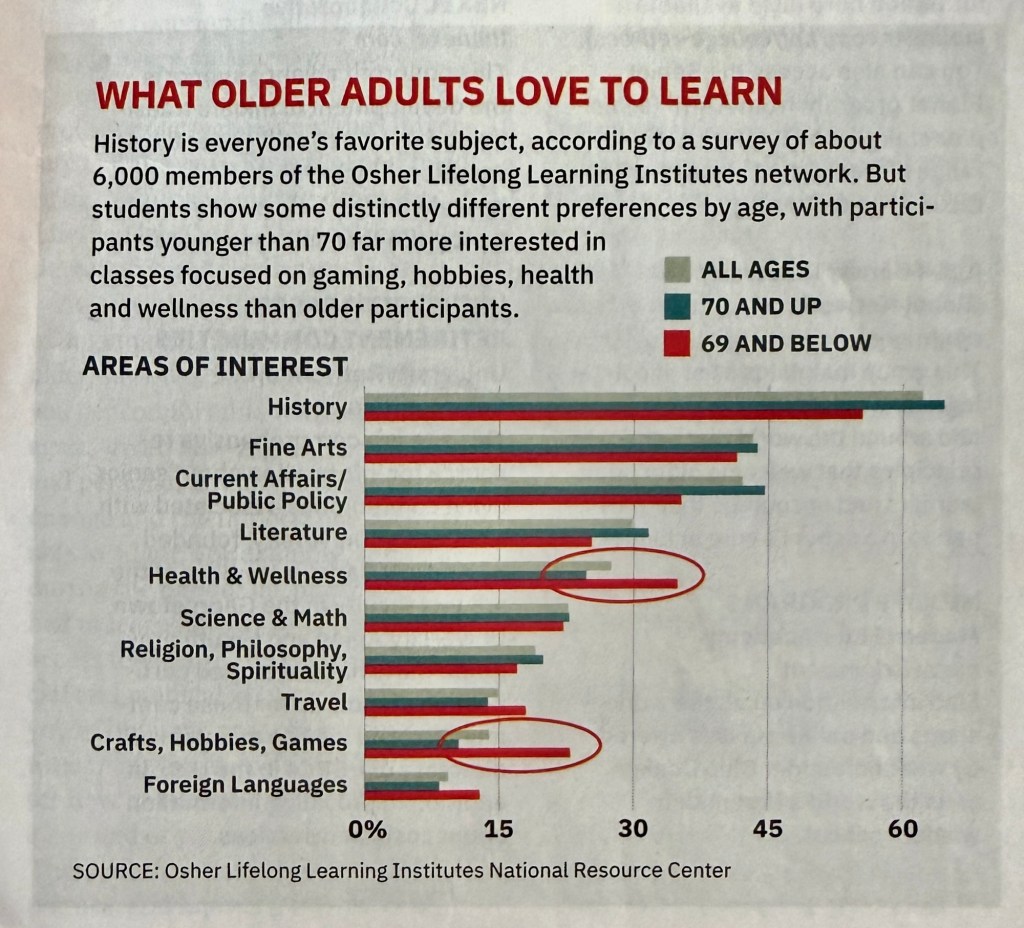
There isn’t much difference between the colors in this chart. They represent people of different ages. I think that there might have been more differentiation if they had done it by sex, rather than age.
I am a bit surprised that “fine art” and “literature” are in the top five. History makes sense to me, as does public policy, but I didn’t realize that the high-brow arts have such a following. Maybe “literature” just means juicy summer romance novels?
I am also surprised that religion / spirituality / philosophy are a bit lower on the list. I would think as people get older, these would become more engaging topics.
What are you currently learning about / studying?
Image: Pixabay


I am always reading a book and alternate between fictional and educational. Sometimes the fictional books have are educational and sometimes the historical books are very entertaining.
Glenn Beck and Harriet Parke wrote two books giving a fictional account of living under the United Nation’s Agenda 21. The gist of Agenda 21 is that humans are a blight on the Earth, so the population needs to be greatly reduced, and most people’s lifestyles need to be greatly reduced to consume less resources. And, then there are the elites who do all the planning for society and of course they reward themselves handsomely for the great job they are doing planning.
This correlates with flooding the third world into the USA to ‘share’ our resources and crowding most people into apartments. You own no car, so you take mass transit instead. Everyone must be a vegan to lower your carbon footprint and hell no for air conditioning.
Then there is the elite class, such as Obama, who scolded “Joe the Plumber that he needs to share his wealth and you don’t really need three homes”. Obama owns four mansions in Hawaii, Chicago, Washington D.C. and Martha’s Vineyard.
The most interesting historical book I have read recently is S. C. Gwynne’s “Empire of the Summer Moon.” This was a very interesting read about the settlement of the Western States. Many think, including some agitators in Mexico who are stirring up protests that they need to “reconquesta” the Western States back from the USA.
It turns out that the Spanish, the French after Napolean defeated the Spanish and the Mexicans never actually controlled the Western States because of the Comanche Tribe kept the states from being settled. The Mexicans were not even able to settle as far North as Monterey because of the Comanche raids. The first part of the book entails the rise of the Comanches.
The second part entails one of the most remarkable narratives ever to come out of the Old West: the epic saga of the pioneer woman Cynthia Ann Parker who was kidnapped by the Comanches and her mixed-blood son Quanah, who became the last and greatest chief of the Comanches.
Taylor Sheridan bought the movie rights to the book and will surely develop an excellent series from this.
LikeLiked by 2 people
I’m not much of a book reader, but I really enjoyed all of the researching I did about the American Revolution.
I tend to like to read things that are positive and entertaining as so much of what is happening IRL is depressing and divisive. Even when I don’t go looking for it, it seems to find me!
I haven’t heard of UN Agenda 21 before. Sounds depressing. I guess I’ll have to look it up now. I read that JD Vance just did an interview dismissing free markets and Milton Friedman, so good luck to us all.
https://reason.com/2026/07/02/j-d-vance-hates-milton-friedman/
LikeLiked by 1 person
You are correct, the Agenda 21 books are not an uplifting series. I glanced at your link, and my initial reaction is that I don’t trust a summarization of what J.D. Vance said during the interview and would have to see the actual unedited interview. The article immediately below was celebrating the Supreme Court’s foolish ruling on Birth Right Citizenship.
LikeLike
The article included a link to a video of the actual interview.
LikeLike
I go by the adage “The more you know the more you realize the full extent of your ignorance.”
I also read both fiction and nonfiction.
History is my real interest in reading/research. We are headed to Italy in October thus I am reading more about Italian history post the rule of Rome, but also as to history of Pompei and Herculaneum as we will spend a day at each.
The Smithsonian magazine arrived recently with a story of Thomas Paine which gets me delving into his reading, but also of Rousseau, Locke and the Stoics.
As I mentioned earlier, I recognize my area of ignorance.
LikeLiked by 2 people
Victor Davis Hanson is history author who really is interesting to read. He has material on what caused the Roman Empire to expand and then fail.
LikeLiked by 2 people
I love to combine learning & travel like that! I was almost surprised that the graph had them as separate topics.
CBS Sunday Morning just did a nice piece on Thomas Paine. His hometown of Lewes, England and how the “radicalism” there shaped his thinking & it’s ultimate impact on the USA.
LikeLiked by 1 person
Big fan of Victor Davis Hanson. I follow him on X and read whatever he is mentioned in. He knew that a farmer in the Central Valley would be a thought leader focused on philosophy from the Classics.
David Sacks on All in Podcast yesterday noted despite the $26B that Mackenzie Scott has given away, no problems were solved.
If more people paid attention to First Principles, then perhaps some problems in society would be solved.
LikeLiked by 2 people
I’ve seen VDH a few times, but haven’t followed him closely. What does “First Principles” mean?
LikeLike
VDH’s books include a lot of maps and mentions of structures and monuments that have survived. Could be helpful in trip planning.
LikeLiked by 2 people
First principles are the foundational truths or the building blocks of a subject that cannot be broken down to smaller blocks.
Rather than building upon other “proven” techniques or ideas, discard the old and think of a new way.
This thinking was recently popularized by Elon Musk, both in a new way to build and fly rockets, but also when Tesla was not making production goals and he slept under his desk tackling problems with a new way of how to solve the challenge.
This thinking goes back to Aristotle and continues with great thinkers such as Descartes, Newton, Franklin, Jefferson and others.
I think today (meaning my lifetime) we have had other First Principle types such as John Bolger, Warren Buffett, Charles Munger. I do however look at these financial types of actually building off of Benjamin Graham.
What is unique about visionaries such as Musk and Munger, Buffett and Bolger is that they were not in it to build a fortune, but rather to use their skills and talents to better society.
While Musk is derided today as a wealthy person, he does not live a lavish lifestyle as he works most of the time and does not have time to spend money plus his wealth is not liquid. Remember that in 2021 he paid $11B in taxes as a result of options in Tesla treated as ordinary income. His purchase of Twitter likely provides a method of tax loss harvesting as he overpaid to preserve freedom of speech.
LikeLiked by 1 person
Thanks for that summary. I will look into it a lot more. Sounds very interesting. I’m impressed with Musk. He’s an odd duck sometimes, but his technological legacy is really impressive. His bountiful financial situation is just evidence of that.
LikeLike