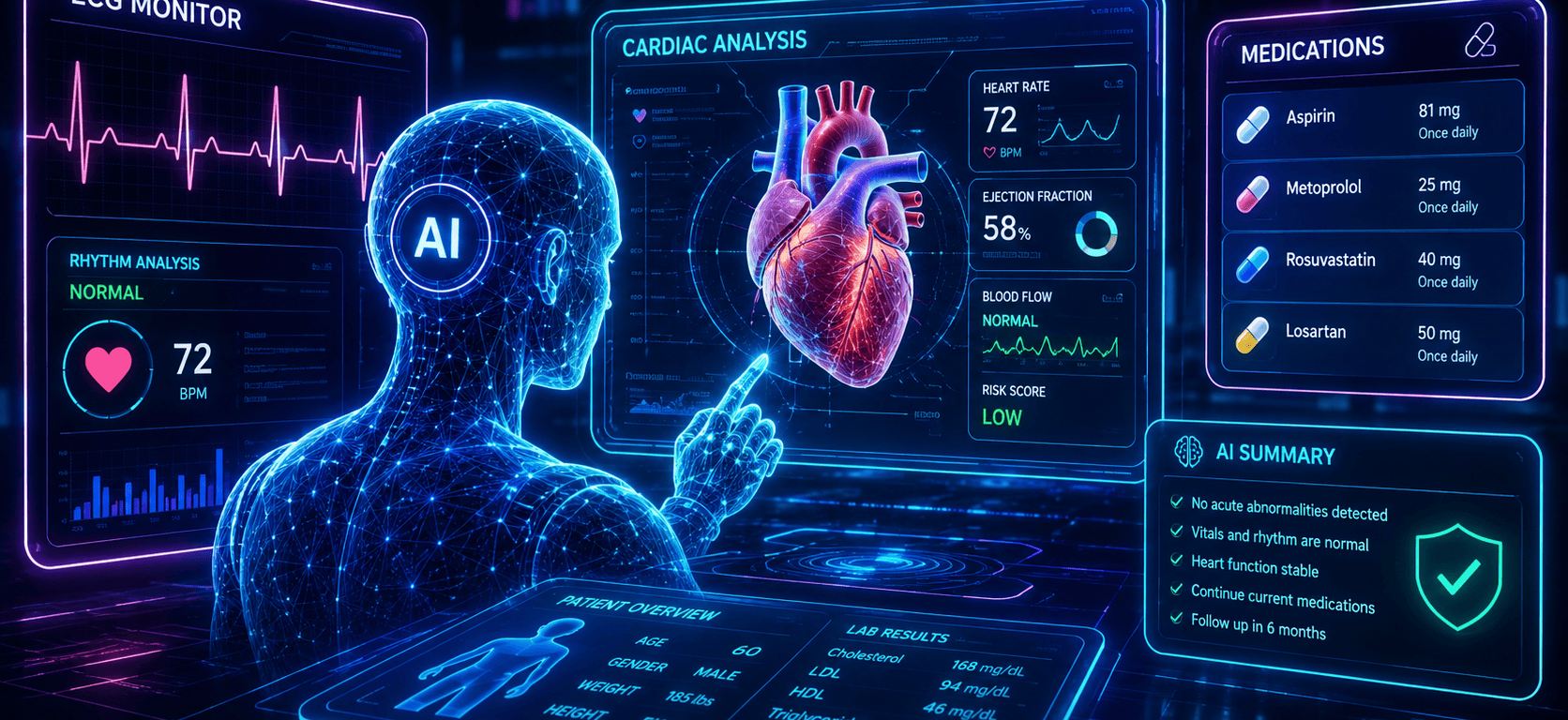
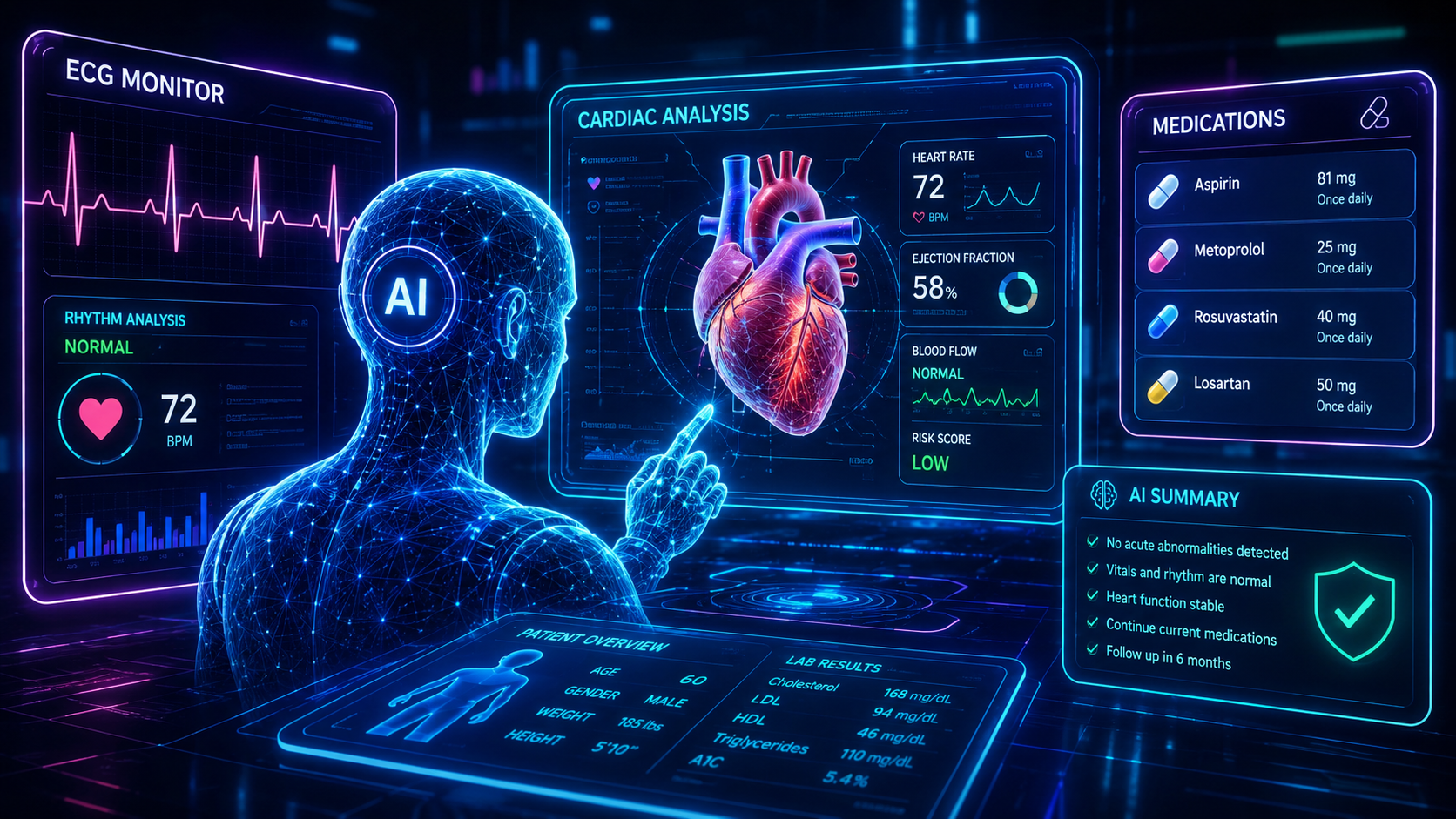
This post will probably make some people cringe, but I think it shows the opportunities of new technology that we will all be benefiting from soon.
I went to my double doctor appointments (GP + Cardiologist) over the last 2 days for check ups. Everything was good and I liked the new doctors. Afterwards, I took the added step to “discuss” my lab numbers and medical history with ChatGPT. I wanted to compare the doctors’ perspective with what artificial intelligence could suggest.
Headline: I really felt like the AI was consistent with the doctors’ point-of-view and gave me a lot more detail on their analysis and recommendations. It was extra helpful.
Since both doctors were new to me, I gave them a 1-pager with a little about who I was, my lifestyle, and known medical issues – most significantly the heart attack I had back in 2019. They also had all of my vitals, blood tests, and medications since I started going to this clinic when I retired 10+ years ago.
I then gave ChatGPT (in a confidential “health project”) the same detail – including a table of all of my weight, blood pressure, cholesterol, triglycerides, A1C, and PSA numbers – over the same period.
I was amazed that artificial intelligence was able to quickly analyze the data, ask me follow up questions about exercise, diet, nutrition, medications, and other health habits – and quickly give me specific prioritized follow-ups that matched the doctors.
It even suggested a few specific medications to discuss with my cardiologist for lowering my LDL cholesterol that the doctor had just suggested to me the day before. Importantly, it was able to describe them in more detail than the doctor had time for – or questions I hadn’t thought about at the moment I was with him.
I’ve used AI to analyze health data before, but I was really impressed when it could create multiple lists of what I was doing well, what it was concerned about, and what changes I could make. It could attack the problems from so many different ways. Each was customized to my exact numbers and situation. It pointed out things that I do very well / not as well with contextual benchmarks that helped frame things for a 60 year-old that has already had a heart attack.
It even had the “sensitivity” to understand that changes had to be made practically and that you cannot “medicalize” someone’s life and expect the changes to be sustainable.
It said “one thing that we know from long-term health studies is that the best plan is the one you can happily follow for the next 20 years”. In discussing diet & my penchant for eating out it understood “that studies show that social connections are associated with better health and longevity, and that eating out with friends & family benefits us that way, too”.
I was really impressed with both of my new doctors this week, but discussing the same issues (and data) with ChatGPT was even more impressive, and strangely inspiring. Importantly, I would never forgo a doctor visit for only advice from AI, but I found the combination of the two really consistent … and powerful.
Have you ever analyzed your health data or “discussed” your health conditions with AI? Would you try it?
Image: ChatGPT (not real health data)


Thanks for your blog post! As far as I know, the idea that LDL is bad for you originates with one Ancel Keys. I thought he was debunked as a fraud. Now that both your physicians and AI still use this theory I wonder what’s going on.
LikeLiked by 1 person
For someone like myself who has had a heart attack, they want your LDL to get under 55, which is quite low. For the general population <70. Those guidelines are also published by the Mayo Clinic here in MN … https://www.mayoclinic.org/diseases-conditions/high-blood-cholesterol/diagnosis-treatment/drc-20350806
LikeLike
I am with you, the recent changes to the Food Pyramid undoes Ancel Keyes low fat research. For what it is worth, Ancel Keys was at Mayo Clinic.
LikeLiked by 1 person
Interesting! I had not heard of him before … https://chatgpt.com/s/t_6a510116e3ac8191abe1ff124c9664a2
LikeLiked by 1 person
Yes and Yes. AI is my first source I use when diagnosing a new health issue. I usually use Gemini and ChatGPT and compare the results. I have also used it to analyze lab results. I would highly recommend it.
LikeLiked by 1 person
Glad to hear I’m not the only one! It’s really amazing with lab results. The table I gave it of past results really got it going on trends.
LikeLike
On a similar thread, have you seen any health insurance portals integrate high quality AI to help with health problems and find the right doctor in your network? My current insurance automated “help agent” is not helpful and I find the external tools are actually better at answering questions. I would be willing to pay a bit more for insurance if the AI agent on the portal would also find the doctor and book the appointment.
LikeLiked by 1 person
No – I don’t think our MN Blue Cross has anything like that. Not that I go on their website very much. I imagine they will all want to add that as a feature as soon as they can.
LikeLike
I have had very similar experiences. AI’s ability to deeply know you as a patient coupled with instant access to all medical knowledge is a profound change in medical care. And we really haven’t even begun to see what this will mean. As wearable technology advances, AI’s integration will yield significant benefits for the patient and the overall medical field.
LikeLiked by 1 person
Completely agree. I know that ChatGPT can now directly link to your financial accounts, so soon I’m sure it will link to your medical files + fitness tracker + food diary app + pickleball DUPR rating! 😆
LikeLike
My son works for an MD who has a thriving practice that is specializes in treating inflammatory diseases including arthritis and gout and is the equivalent to Dr. House who is called in to consult with local hospitals when they have a patient that stumps them. He uses several AI engines to self-check his work and be aware of any new advances or research that can help him help his patients. I will get the names of the AI providers that Doc uses and find out if they are available to everyone.
It is good to double check your doctor. I remembered reading in Forbes years ago about two Australian Doctor Researchers, J. Robin Warren and Barry Marshall discovered that Helicobacter pylori was the root cause of most stomach ulcers in 1983. Their discovery was mocked by the medical community, and their research was turned down for publication. Dr. Marshall even gave himself an ulcer and successfully treated it using antibiotics. In 1994, The NIH recommended using antibiotics as the frontline response to most stomach ulcers. Yet, most physicians failed to follow the recommendation. It took around 20 years for this discovery to become the norm. The two Doctors received the Nobel Prize 22 years later in 2005. Today, probiotics can be used to normalize gut bacteria.
LikeLiked by 1 person
Better late than never for those doctors’ discovery, but too bad for all of the patients that suffered for 20 years. I think that probably happens more than we know.
When I met with my general practitioner yesterday, he recorded the whole conversation on his phone, which he said then would AI summarize our visit for him. I wonder if it also plays the role of a self check on the advice that he gives?
LikeLiked by 1 person
Here is another area where there seems to be a 20-year lag time. The Nobel Assembly at the Karolinska Institute in Stockholm, Sweden, has awarded the Nobel Prize in Physiology or Medicine for 1998 to Robert F Furchgott, Louis J Ignarro and Ferid Murad for their discoveries concerning “the nitric oxide as a signalling molecule in the cardiovascular system”.
Nitric oxide is very present in young people. Nitric oxide causes your blood vessels to expand and contract to meet physical demands. As you get older, your body loses its ability to produce as much nitric oxide. Nitroglycerin tablets, Viagra and Cialis all temporarily increase nitric oxide. There are natural ways to restore Nitric Oxide levels.
From my reading, I think the model for cardiovascular disease is moving towards being focused on reducing inflammation, balancing blood sugar, and restoring nitric oxide levels to youthful levels.
There has been a lot of bad medical care provided under the bad words, “Standard of Care.” Whenever a doctor or Dentist uses the words “Standard of Care” with me, I respond that bloodletting was the Standard of Care during George Washington’s time and has been attributed to killing him.
LikeLike
I have not utilized AI with medical questions but clearly this is the future.
My last visit to Urgent Care for sinus infection the doctor recorded the visit which I like.
My kidney disease was discovered by early computer assisted diagnosis. My blood pressure did not lower despite exercise, diet and losing weight and Kaiser computers suggested a kidney ultrasound which demonstrated the presence of cysts which is my disease.
I am bullish on AI and medical diagnostics and breakthroughs.
LikeLiked by 1 person
I just read your posted AI synopsis of Ancel Keys and it seems to be accurate and balanced. Here is what I think happened, he recommended the Mediterranean Diet, which I tend to follow myself. The proof is in his longevity by the fact he lived to be over 100 years old.
Here is where I think it went all wrong. There were marketing types who jumped on the low-fat bandwagon. They marketed refined carbohydrates and bad ingredient laden ultra-processed food as low fat or fat free.
This reminds me of a friend of mine who wanted some coaching on health and as an example he was eating high protein bars mid-morning and was wondering why he his energy was crashing. I had him send me a picture of the ingredients and then asked him to read them to me. The number two ingredient was high fructose corn syrup and there were a bunch of ingredients that neither of us could pronounce. Here are two simple rules, avoid simple carbs and don’t put things in your mouth that your mouth cannot pronounce.
He recently told me that he is 69 years old and he is now in better health than his children. His wife, who is 70 has gone off blood pressure meds and her doctor tells her that whatever who did has added years to her life. Her family typically passes away in their early 60s. She is breaking the family history.
LikeLike
“Breaking family history” is the goal that my Dad had. His Great-Grandfather Frank lived from 1840-1930 – a few months shy of 90 years old. No other blood relative that we could find had lived that long. My Dad passed away a couple years ago at age 91 years, 4 months.
I think my Mom is getting close to breaking her family record, too. She’ll be 88 this year. Her Dad passed away at 89 years old and her Mom was 86. Her Grandparents did not live that long, but I would have to look into some detail to see aunts, uncles, and other generations.
Having made my living marketing “refined carbohydrates and bad ingredient laden ultra-processed foods”, I certainly understand the nutritional difference. Still, we all make our own choices and trade-offs …
LikeLike