It has been a while since I looked closely at what we are paying for health insurance. I knew it had been going up, but I didn’t look at it until a MegaCorp colleague asked me about it how much it was.
When I retired in 2016, health insurance was one of the biggest unknowns in our FIRE financial plan. Unlike most retirees, we needed coverage until we would qualify for Medicare until age 65. That meant nearly 15 years of finding and funding our own coverage.
Fortunately, we got access to a retiree health insurance plan through my former MegaCorp employer when I turned 55. It isn’t especially cheap, but a little less expensive than if we bought it outright. It has provided high-deductible catastrophic coverage throughout our early retirement years.
Here’s how our premiums and deductibles have trended out over the years …
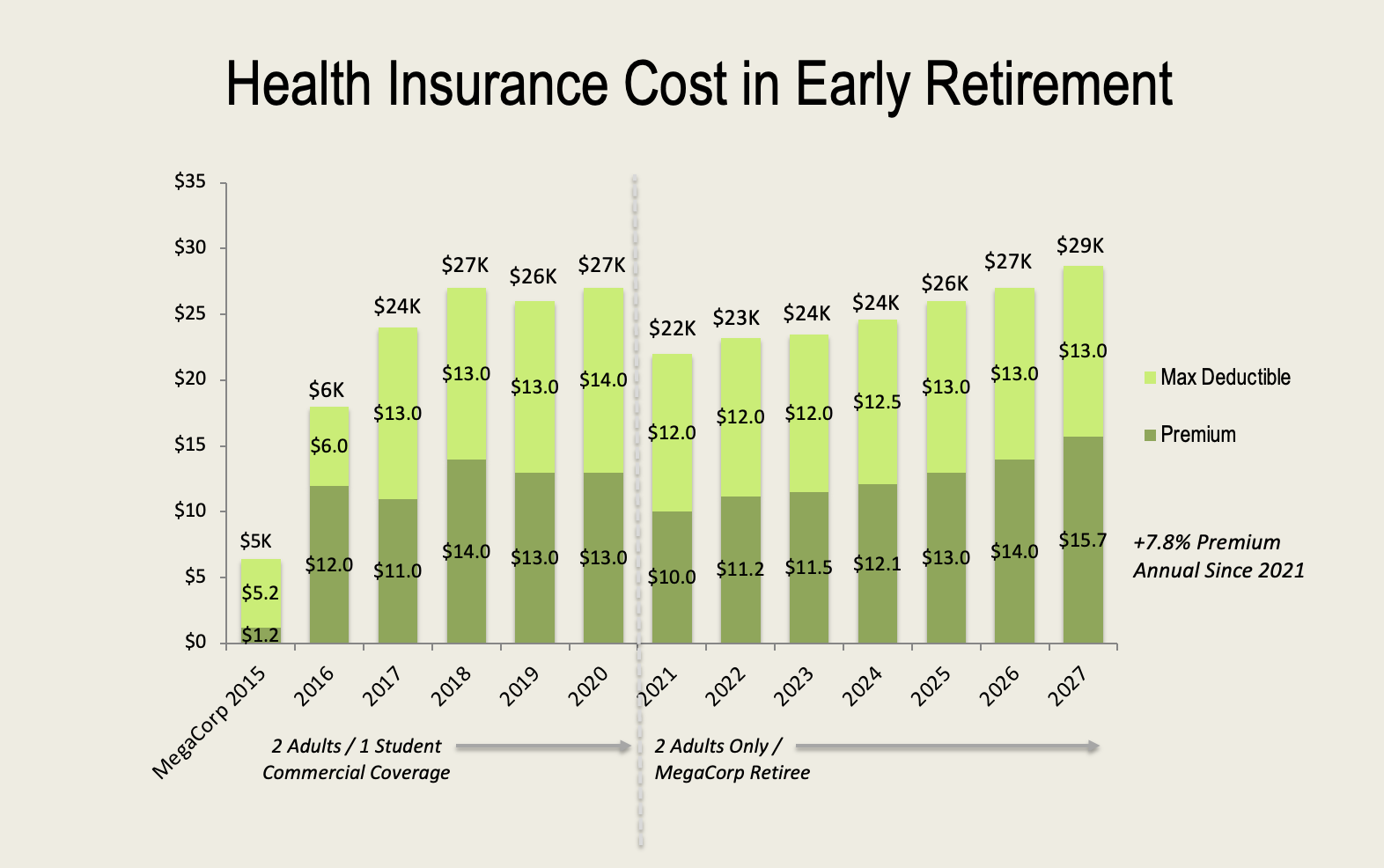
It’s jumped around a bit because of changes in the market, changes in our coverage, and changes in our household composition. We went from employer-sponsored plan in 2015 & 2016, to commercial coverage for the next 4 years (including our college student son), and then to MegaCorp retiree insurance for just the two of us.
Over the longer term, our premiums have gone up 7.8% a year since 2021 when we went on our current coverage. According to the Kaiser Family Foundation, which tracks insurance prices, that’s quite a bit more than the 5.1% health insurance costs have gone up nationally.
As you can see, our premium will go up to $15,700 in 2027 (or about $1.3K/month). That’s a whopping +12.7% increase from what we paid last year for the same basic plan.
National forecasts suggest 2027 will be another painful year nationally, as we are seeing. Employer-provided plans are expected to jump about +8%, ACA Marketplace plans have a median increase of 15%, and Federal employees are seeing a +9% increase.
Healthcare remains one of the trickiest expenses to forecast in early retirement. Unlike vacations, cars, or restaurant meals, health insurance isn’t something we can easily eliminate when prices rise. The culprits are familiar: rising hospital and physician costs, expensive new treatments, specialty medications, and greater use of healthcare services. Popular GLP-1 weight-loss drugs are adding to the pressure, too.
The good news? Medicare is finally getting closer for us (Boomer Socialism!) Until then, we’ll keep paying the bills, appreciating our coverage, and staying as healthy as we can.
How are your health insurance costs changing for 2027?
Sources: Mercer 2027 Health Benefit Cost Survey, International Foundation 2027 Cost Trend Survey, and KFF 2027 Marketplace Premium Analysis.

