

How’s your memory? A few people I’m close with are dealing with early-onset dementia and late-onset dementia. A woman in her 60s, a guy who is almost 70, and my Mom who is in her late 80s. It’s a really difficult thing to see. People that were completely independent a few years ago who are now unable to function on the most everyday of things.
My Mom’s been dealing with dementia for 5+ years. Her Dad had it. I thought dementia was pretty common among most people her age, but I was surprised to actually see how relatively uncommon it is. She was born in the late 1930s and only about 10% of people in her age-cohort (85-89) suffer from dementia.
You can see her age-group in the orange line from this chart published in The Economist …
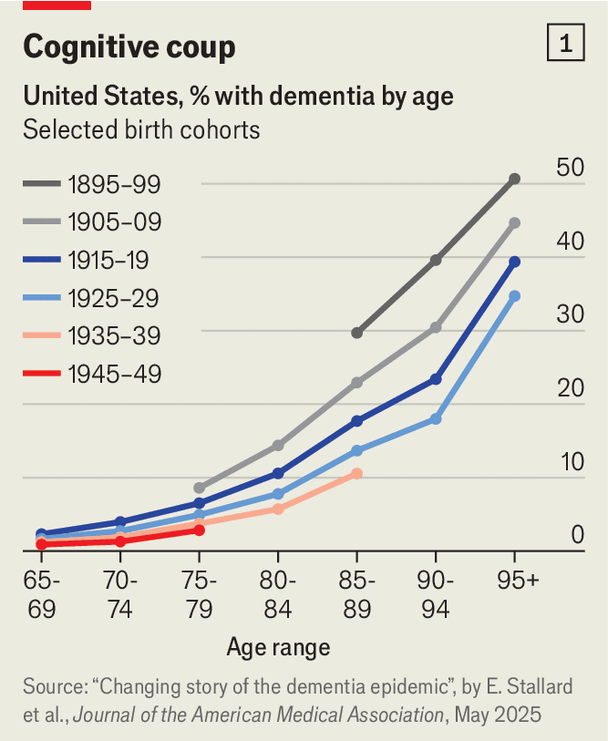
The chart shows that the incidence of dementia doesn’t even jump very high in one’s early 90s. My Dad was 91 years old when he passed away and never had the issue. You can see from the light blue line in the chart that less than 20% of the people in his age group (90-94) had dementia.
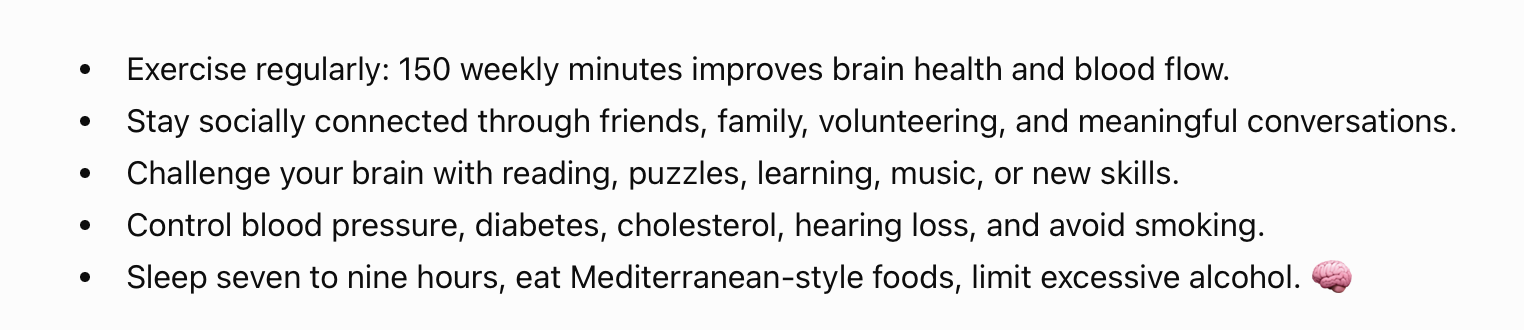
There isn’t one easy way to avoid dementia. If your parent has dementia, you are 1.5x-2x more likely than the table above to develop it. Below are 5 things the The Lancet Commission on Dementia Prevention, Intervention, and Care recommend. They say these things can reduce your risk by 45-50%, which pretty much gets you back to “baseline” risk if your parent had it.
Here’s what they recommend … pretty much the same things we can do to be healthy in other ways.
Is there a risk of dementia in your family? How do you think about it as you age?
Image: Pixabay; Chart: The Economist
 MrFireStation
There has been none in my family. I have already been following the guidelines on your five recommendations for decades.
Food supplements are an emerging area that is showing promise in slowing down the progression of and reversing memory loss. Here are a couple for you to run through your AI process.
Homemade kefir improves the gut brain axis reducing inflammation in the brain. Kefir that is homemade has orders of magnitude higher CFUs (colony forming units) and diversity of probiotic strains.
NMN (Nicotinamide Mononucleotide) improves cognition.
Microdosing Lithium (lithium orotate) reduces progression and helps improve memory.
COQ10 diminishes with age and statins. It will increase your overall energy, heart health and circulation to the brain.
These have research that backs them up, but most people don’t hear about them, because since they are natural, they cannot be patented to jack up the price and support large marketing budgets.
LikeLiked by 1 person
Thank you for sharing, Sir – I think you’ve mentioned homemade kefir before. Do you take the other supplements?
LikeLiked by 1 person
You are welcome. I am currently taking everything except the micro dose of Lithium which I will be starting after I receive my monthly supplement shipment in early August. For me it isn’t as much about Alzheimer’s as improving my cognition.
My wife and I started taking 100 mg of Life Extension’s AmpliQ CoQ10 almost two months ago. Both our energy levels have dramatically increased. I have less brain fog and jump into projects and get things done early and still have most of the day to goof off. It has diminished my afternoon crash. AmpliQ is a Special formulation to increase the absorption. CoQ10 has cardiovascular benefits too.
I just learned about micro dosing Lithium during the past month. The studies on low dose Lithium showed it slowed cognitive decline. Studies from areas where trace amounts of Lithium are in the drinking water have 71% lower incidence of many types of cancer and the populations’ telomeres shorten more slowly.
LikeLiked by 1 person
Wow – Lithium. That sounds kind of scary. I take my heart medicine and a baby aspirin each day, but I’ve never taken any supplements or even a multi-vitamin. You research things well, so I’m sure there is science behind it. I’ll have to read up.
LikeLike
Like Klaus, I also follow those five guidelines.
The only dementia experience in my family involved elderly relatives in their late 80s, that is until a close family member diagnosed at 66.
I did have a close friend diagnosed at 68 and passed at 75, the last year was very challenging. He always had a vague nature about him despite being very healthy with lots of exercise and eating right. I think there was a genetic component.
I am not worried about it as my family for the most part lives to old age and those who had strokes or heart disease did not have issues until their 80’s and much of that was diet related, bacon and eggs and high fat. My family members like me with polycystic kidney disease did not live long enough for dementia or stroke/heart issues. My kidney disease is my cross to bear. There is not a lot for me to do beyond what I already do so I don’t worry. What will be will be and I feel that I have lived a full life and when my time comes I am ready, but I do want another few decades.
LikeLiked by 2 people
It sounds like you have a good heads-up on the kidney disease. Many families probably have a better understanding of their heritable risks now than ever before. I’m sure those 5 guidelines could help people with a lot of risks.
LikeLike
Have ever tried homemade kefir. Here are a couple posts about kefir and kidney health.
https://www.culturedfoodlife.com/your-kidneys-might-need-some-kefir/
https://www.culturedfoodlife.com/lives-touched/carolyn-sue-barr/
I bought my kefir starter grains from Donna. She is located in Southern CA.
LikeLiked by 1 person
Here are the links … required “approval” for some reason
LikeLike
Have you ever tried homemade kefir? It consumes urea and creatinine in your gut and can improve function.
I bought my Kefir Starter Grains from culturedfoodlife in Southern California.
I tried to post two links for you, but WordPress must have deemed them dangerous.
Search “culturedfoodlife your kidneys might need some kefir”
Also try “culturedfoodlife caroline sue barr”
LikeLiked by 2 people
Thanks for the suggestion, I see my nephrologist next week and will ask her. This is my third nephrologist as my first two retired. I did search Kefir and note that it is low in potassium which is what I try to avoid the most, but you point out how it would benefit me.
LikeLiked by 1 person
Sounds like you are on the low phosphorus diet with a phosphorus blocker. With kefir you have the trade-off of adding a little phosphorus and to gain the benefit of the probiotics consuming the creatinine, urea and uric acid before they get to your bloodstream. Thus, taking additional load off your kidneys.
Are you taking CoQ10? It is a very powerful antioxidant that slows kidney disease progression.
LikeLiked by 1 person