

The discussion in the comment section after my Monday post this week focused a lot on mortgage rate history. It prompted me to find this graph on 30-year fixed standard mortgages from 1971-2025.
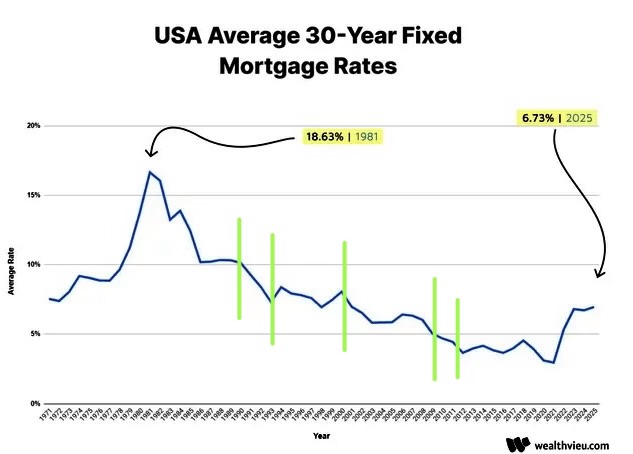
I remember the peak in 1981 as we moved that year for my Dad’s job and my parents got a 16% mortgage for our new house. Bad timing. It was quite a financial strain for our family until they were able to refinance to a much lower rate after about 4-5 years.
The green bars I added are some key dates in our own history with mortgages.
The first green line in 1990 is when we got married and bought a small condo (for $24K!). I think our mortgage rate was about 9%. We probably wouldn’t have even qualified for that, but it was the era of “assumable” mortgages. If the seller had a mortgage, the buyer just took over for them. Strange to think about those now.
The second green line in 1993 was when we bought our first single-family house. A nice, three bedroom, 1800 sqf split- level that was only 7 years old. Our rate was about 7% at this point, which we felt good about because it was lower than rates had been in some time.
Our next house – the first one we had built – was in 2000. It was a custom-built 3,500 sqf house on a nice cul-de-sac with a lot of families. Rates were going up for the whole year we designed & built the house. We ended up at 8% and kept the house for 9 years – frequently doing no-cost refinancing over that time.
We moved in our current house in 2009. On Halloween Day. We put a lot of cash into the purchase, but still had a mortgage at about 6%. Our rate was about 1pp higher than the chart as we rolled all the closing costs into the rate. We only had the mortgage for about 18 months before we paid it off in 2011.
In the years after our last mortgage payment, rates continued to fall. They fell to 2.75% nationally in November of 2021. At that point, we were long out of the mortgage game. I suppose we could have put a mortgage back on the house and invested the proceeds, but that’s isn’t something we ever even considered.
What are some of the notable milestones in your home / mortgage journey?
Image: Pixabay


I moved onto the acreage where my house is today in January 1989. I lived in a trailer, I bought for $1200 and work on my house during the evenings and weekends. My financing back then was a seller note on the land at 10% and construction financing at 15%.
Before the end of 1990, I was able to move into my house and refinanced the note on the land and the construction financing with a conforming first mortgage and a second mortgage with my credit union. The rate on the first would have been around the 10% shown on your graph.
In 1993, my wife and I got engaged, and we refinanced the mortgage with my credit union. They offered 10 year term mortgages with 30 year amortization at a rate below the graph. I think it ended up around 6.9%. The credit union offered slightly lower mortgage rates and paid slightly higher interest to its customers. I remember them telling us, ours was their largest mortgage. They were actually lending us other customers’ money and serviced the mortgage themselves.
In 2002, we had to refinance the 10 year term mortgage to reset the the 10 year term with 30 year amortization over again. We ended up around 6%.
In 2009, if you had a job and adequate equity in your house, you could refinance. We refinanced to lock in a 30 year term at 4.75%.
We refinanced again in 2016 to get the rate down around 3.75%. I remember the appraiser charged $800, because we had a high value house. I didn’t like this because we had around 3X the equity of the loan amount.
In the fall of 2021, right before BiDUMB’s ‘election’ with suspicious mail-in ballots and voting machines, we refinanced again to reduce our monthly payment. The loan agent worked with us to simplify the process. He had me only list my Deferred Compensation Income to skip having to do employment verification or look at a statement from consulting. On the application we listed the house as being under a million, so that he use FNMA’s new desktop appraiser. It was the quickest and easiest loan ever and we got 2.75%
These were a lot of refinances, but we never treated our house as a piggy bank. We only refinanced the principal and wrote checks to cover the garbage fees.
Ironically, the same day that I wrote about looking at 2.75% as an inflation hedge and you never truly own your property because you have to pay the feudal landlord for the right to continue living on your serf holding for another year, I received my annual serf’s bill. Most of my property taxes are covered under Proposition 13 which limits the rate of increase to 2% annual increases. Local governments have been cheating on Proposition 13 and through tacking on BS fees, like homeless fees increased my year-over-year serf fee by 4.8%. If you live in California Vote Yes on Proposition 43, which closes the loophole local governments have been using to tack on BS fees to your annual serf’s bill. Even if you rent, you want this, because higher Real Estate Taxes are a cost driver for your rent.
LikeLiked by 1 person
I’m surprised that construction loans were still that high in the late-1980s. I guess they don’t benefit from having a finished house serve as collateral, though. Other than that inauspicious start, it sounds like you successfully rode rates down – decade by decade – to the lowest they’ll likely be in our lifetimes. I really don’t see them going down to 2.75% again in the next 20+ years.
LikeLiked by 1 person
I think your assessment of construction loan risk is correct. Construction loans also require more work from the bank. They have to send someone out to verify that the work has been actually done correctly before they release funds. I was highly incentivized to complete the house and refinance to a conventional mortgage.
I remember the refinance I did in 2009 thinking that it was the cheapest rate we would ever get. I continued monitoring rates and they continued to drop. Whenever, they dropped enough that I could recover paying the garbage fees in one to two years, I refinanced again. I keep doing this whenever rates caught and was able to catch the 2.75% low.
LikeLiked by 1 person