

I was at a wonderful MegaCorp reunion a few nights ago and a few colleagues were celebrating their first year of retirement, or were planning to at the end of the year. A couple friends said that despite a lot of planning, they weren’t entirely confident that their financials were going to hold up to the next few decades of retirement life.
Despite having financial advisors and having done Monte Carlo analyses with tools like FIREcalc.com, many people are still nervous. According to research, about 70% of people worry if their savings are going to hold out.
My initial reaction is that they shouldn’t worry so much. Especially people retiring from good jobs with a healthy nest egg. Our portfolio is actually much bigger than what we retired with – despite a whole decade of retirement spending behind us. (The S&P returned a healthy +11.9% annually above inflation over the last 10 years).
I would find it hard to believe that our nest egg will swing to the negative in the next 10 years, but a recent study from the Employee Benefit Research Institute, shows that many retirees are in exactly that situation.
As the chart below shows, the share of people with “LESS” money than half of what they started with (in purple) is higher than the people with “ALL” or more assets left (in orange). The discrepancy is especially for sharp for households that started with less than $200K in savings.
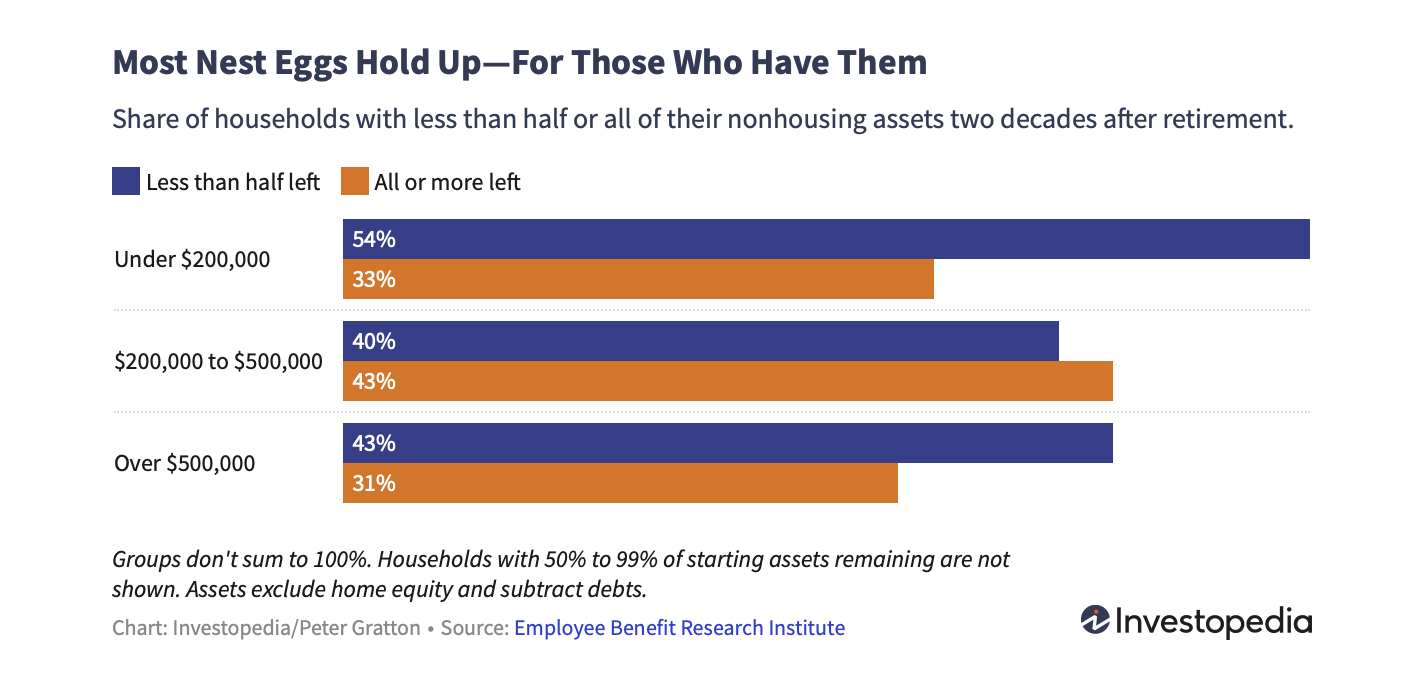
And, keep in mind that this chart starts in an optimistic place. It only includes people that have ANY savings at retirement. About 30% of American households retire WITHOUT any savings and rely almost exclusively on Social Security. Those people are truly at the mercy of the inflation / Social Security COLA cycle each year.
How long have you been retired and how are your retirement savings holding up?
Image: Pixabay


We have been retired for 6 years and our investments are up 48.3% after paying ourselves.
A lot of people who fear running out of money are actually losing out to inflation, which makes their income become worth less and less over time. I think a better way to look at retirement financing is how much your income is increasing every year. We have been averaging around 7.2% annual increase over the duration, so we are staying ahead of inflation. The annual increases are covered by reinvesting some of the dividend income and dividend increases.
LikeLiked by 2 people
+48% is a great result. We’re at +65% after 10+ years. When I retired, I was sure that the balance would go down, so anything that’s positive is a real positive.
I don’t really look at income anymore. The only time I see it is when we do our taxes in April. Ours has been pretty “lumpy” as we had stock option, real estate purchases & sales, and lots of other one-time events that make the number bounce up & down.
LikeLiked by 1 person
Sounds like you, Dorothy and me have equivalent results.
The income I am referring to is the annual income from my investments that are dividends and distributions which is a different income then the amount that goes on taxes. Annual income is buried at the bottom of brokerage statements and for dividend and distribution investors can be turned in spendable cash without selling shares.
My wife was very worried about retiring. I think a lot of the fear was caused by working with RN’s who were not good at money management and hearing negative talk about running out of money or not having enough saved up. Being able to show her smooth and predictable income that is growing faster than inflation assuaged the concerns.
LikeLike
I have been retired 7 years as of last week. Financial Assets up 49.4%.
I have a pension and my wife has social security, and we have not pulled anything from financial assets beyond investment fees and taxes plus about $80,000 for financial gifts to children and travel.
While I am retired, I still do some consulting, but 46% of revenue goes to taxes and the remainder goes to travel.
I recognize that I am an anomaly. When I stop consulting and that is an if, I could start to draw from assets, but need is much less than 2% of assets so I can confidently say that we will never run out of money. The opposite will be the case as when I reach the age of RMD from IRAs, the RMD will likely exceed need.
LikeLiked by 2 people
+49% is a great result! We’re at +65% after 10+ years. We have a pension, but no SSI yet. We’ve certainly cashed in some assets, but the balances have grown well beyond what we have taken out. I had some board income for the first 9 years, but we put that into savings for “fun stuff” – including our vacation place in FL. How long will you continue consulting?
LikeLike
we live in generous times. I only “work “ about 3-4 months spread out over the year. I keep thinking that I have had my highest income years, but then there is more need for my services. Expect to continue for another six years which is age 70, but likely not at the same rate. My core work is about six weeks total and while it is a flat fee per project, it is lucrative on an hourly basis and there is a component of giving back through education of clients and I generally speak at an annual conference which is pro bono and I pay for own travel and hotel.
Like I said,it isn’t work for me but I do receive income.
LikeLiked by 2 people
That sounds like a purposeful retirement vocation. Not too much work, paid for what you already know, you can be flexible about when you can take it, and it’s meaningful to you and your clients. That terrific.
LikeLike
We are waiting for RMDs before hitting our IRAs too. Also waiting for age 70 to claim Social Security.
LikeLike
I do not complain about my being “overfunded” for retirement, but I do feel that many of us were sold a bill of goods on deferred accounts. The message that your investments grow tax free and when you take distributions you will be at a lower tax rate!
That is why I tell all young people to use Roths and forget about the tax saving today.
While many in society don’t feel that the rich pay their fair share in taxes don’t recognize the amount of tax receipts due to distributions from IRAs and 401Ks along with the jump in taxable income of the recipient which causes Medicare premiums to increase.
The Medicare for all crowd think that Medicare is welfare for older people not realizing that it is anything but free! Having said that I support the system and social security as both keep elderly out of poverty which was the original intent.
LikeLiked by 1 person
I agree with Dorothy’s assessment about tax deferred accounts causing drifting into a higher tax bracket and excess Medicare IRMAA premiums. Qualified dividends are great tax deal these days. 0% for a Married Couple filing jointly up to $96,700 and only 15% up to $600,000. Back when we were being sold on the idea of saving in tax deferred accounts, tax rates were much higher and Qualified Dividends weren’t the great tax deal that they are today.
LikeLike